App Store Sees Surge in New Apps Amid Growth of No-Code Platforms in Early 2026
July 21, 2026
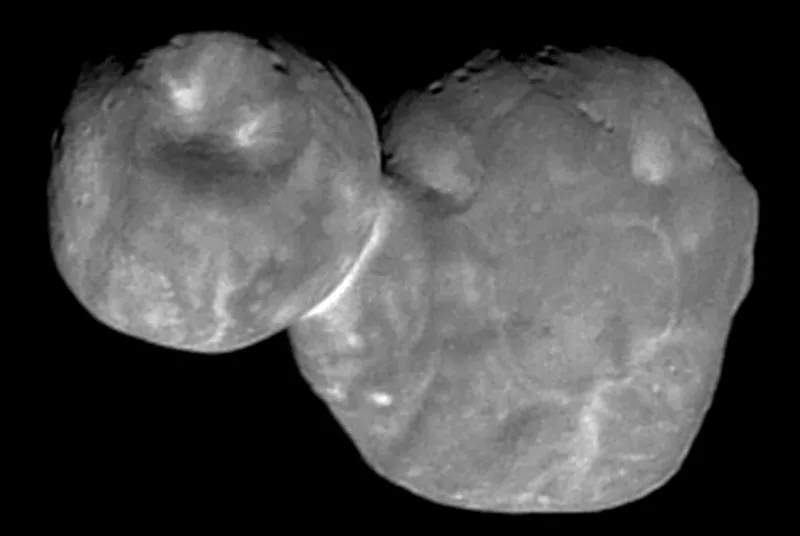
In 2019, NASA’s New Horizons spacecraft captured the first detailed image of a distant object beyond Neptune’s orbit, revealing a peculiar shape resembling a snowman. This object, known as 2014 MU69 and informally referred to as Ultima Thule, surprised scientists with its unique appearance. Since then, researchers have noted that this snowman-like configuration is not an anomaly but a common characteristic found in about 10% of Kuiper Belt objects.
The Kuiper Belt, a vast region of space beyond Neptune filled with small icy bodies, has long intrigued astronomers. The distinct morphology observed in these objects, featuring two lobes joined together, raised questions about their formation and evolution. It was unclear whether this shape resulted from random collisions or if there was a deeper explanation behind it.
Over the past six years, scientists have conducted extensive analysis through observational data and modeling to uncover the underlying reasons for this recurring shape. Their efforts culminated in a new explanation that attributes the snowman-like form to early accretionary processes in the Kuiper Belt. Instead of high-speed impacts, the objects likely formed through gentle merging of binary pairs, gradually fusing without violent collisions. This slow, low-energy coalescence could account for the distinctive bilobed structures recorded.
These findings not only shed light on the physical characteristics of these distant bodies but also offer broader insights into the conditions prevailing at the Solar System’s outermost boundaries during its formation era. Understanding the shape and structure of Kuiper Belt objects improves knowledge about the processes influencing the development of planetesimals in the protoplanetary disk.
The identification of snowman-like shapes in such a significant fraction of Kuiper Belt objects demonstrates a non-random pattern in their morphological diversity. This advance permits refinement of existing models regarding the Solar System’s formation and the dynamical interactions that shaped its current architecture.
Ongoing studies are expected to further explore how these bodies’ physical properties affect their trajectories and potential interactions with other Solar System objects. As missions continue to probe these remote regions, scientists anticipate uncovering additional secrets about the composition, structure, and evolution of Kuiper Belt inhabitants.
The discovery and subsequent explanation of these snowman-shaped bodies represent a milestone in planetary science, highlighting how new data can challenge previous assumptions and deepen understanding of the Solar System’s distant frontiers.
Researchers reveal why roughly one in ten Kuiper Belt objects exhibit a distinctive snowman shape, following NASA’s 2019 New Horizons discovery.