Intel Initiates New Round of Layoffs in Data Center Group Amid Efficiency Drive
July 21, 2026
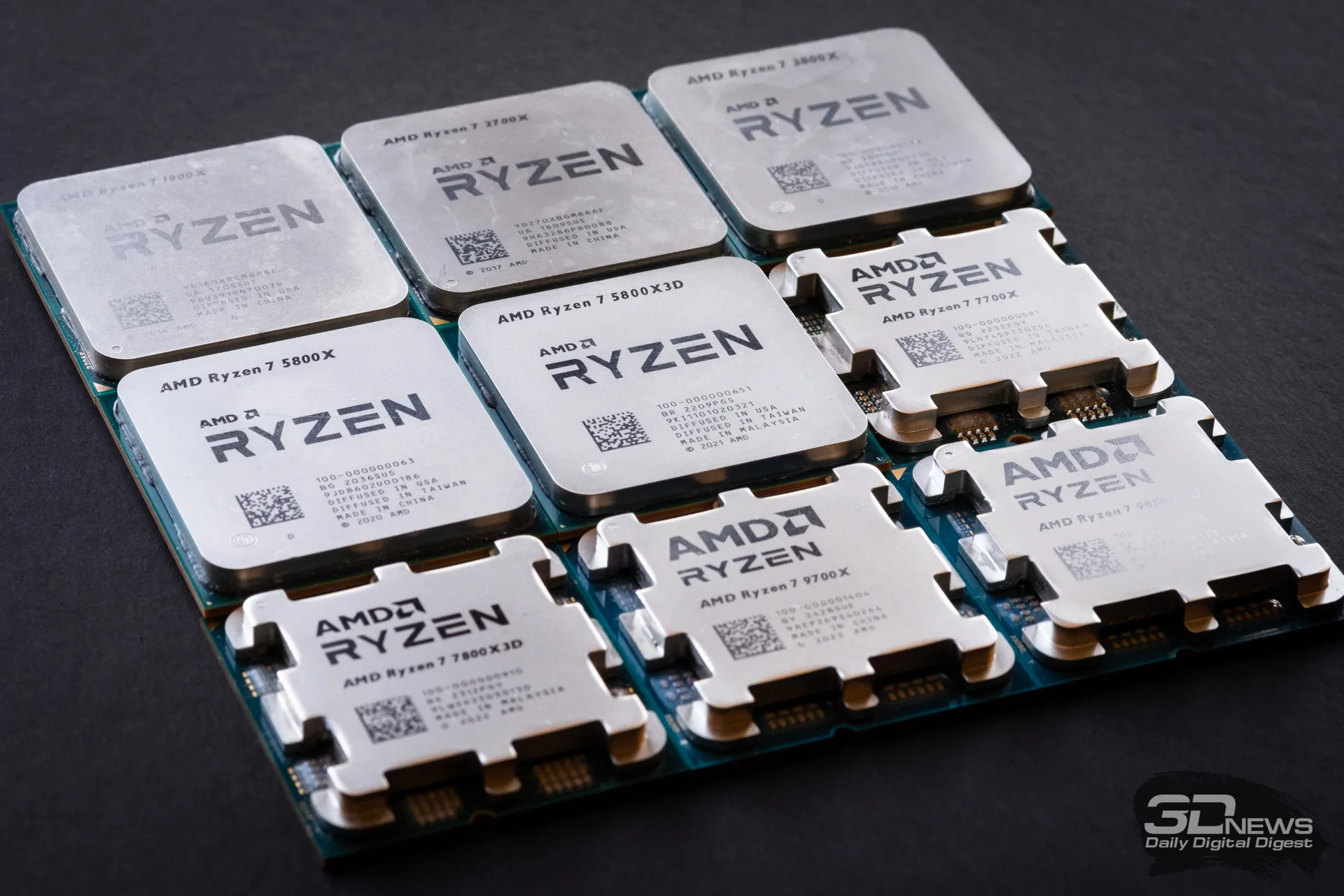
AMD’s Ryzen 7 series has undergone significant advancements since its introduction in 2017, showcasing substantial gains in both performance and efficiency. A recent comprehensive comparison examined nine major eight-core Ryzen 7 processors released over nearly a decade, tracing the evolution from the original Ryzen 7 1800X through to the latest Ryzen 7 9850X3D.
The tested lineup includes the Ryzen 7 1800X, 2700X, 3800X, 5800X, 5800X3D, 7700X, 7800X3D, 9700X, and the recently launched 9850X3D. Together, these processors illustrate AMD’s ongoing refinements in core microarchitecture, manufacturing processes, and cache implementations.
Over the examined period, Ryzen 7 CPUs have demonstrated marked improvements in computational speed and energy efficiency. Performance benchmarks indicate that processing power has tripled, reflecting advancements in core design and clock speeds without a corresponding increase in power consumption. Simultaneously, efficiency has roughly doubled, signaling enhancements in transistor technology and power management strategies.
The evolution highlights AMD’s commitment to meeting growing computing demands while adhering to stricter energy standards. Features such as the introduction of 3D V-Cache technology in later models, including the 5800X3D and 9850X3D, contribute to improved gaming and workload performance by increasing cache sizes that speed up data retrieval.
These processors also reflect shifting market dynamics and user needs, with iterations adapted for both general-purpose and high-performance computing scenarios. The growing presence of 3D-stacked cache designs and refinements in chiplet architecture signify AMD’s innovative approaches to maximizing computational throughput.
While detailed pricing and availability specifics were not examined, the Ryzen 7 lineup’s steady progression underscores how AMD has consistently pushed the envelope in the desktop processor segment. These improvements align with broader industry trends toward integration of advanced manufacturing techniques, sophisticated power management, and expanded cache architectures to meet modern application requirements.
The nine processors studied offer a clear timeline of technological advancements that have allowed AMD to maintain competitiveness and relevance in a fast-evolving semiconductor landscape. The results suggest that AMD’s strategy of iterative enhancements combined with targeted innovations has effectively balanced raw performance with power efficiency gains, benefiting a wide range of consumer and professional users.
A comparison of nine key AMD Ryzen 7 eight-core CPUs from 2017 to 2026 reveals tripled performance and doubled efficiency.