US Considers Restrictions on Chinese Open-Weight AI Models Including Kimi K3
July 21, 2026
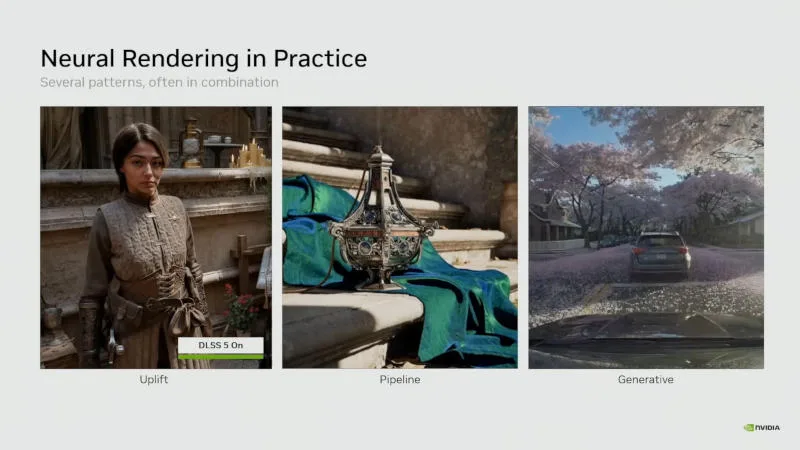
During the GTC 2026 conference, Nvidia demonstrated a new AI-driven approach to texture compression that promises to significantly reduce video memory demands in graphics applications. This development builds on the company’s advancements in neural rendering and artificial intelligence-powered graphics technologies.
The new technique uses neural networks to compress textures, which are critical graphical assets in games and other 3D environments. By leveraging AI to efficiently encode texture data, Nvidia reported dramatic reductions in memory usage, achieving nearly a sevenfold decrease compared to conventional methods.
Unlike other innovations that require changes to rendering pipelines, this neural compression is designed for seamless integration. It can be applied within existing game engines and rendering systems without necessitating fundamental alterations to the workflow. This compatibility makes the technology particularly appealing for developers looking to optimize resource consumption without extensive software redevelopment.
In addition to neural texture compression, Nvidia also showcased its ongoing initiatives in neural rendering technologies at the event. These solutions aim to enhance graphical fidelity and performance using learned models that predict and reconstruct visual details efficiently.
One highlight of the conference was the presentation of DLSS 5, an artificial intelligence-based image scaling technology. Although sections of the presentation suggested DLSS 5 might take a highly ambitious or experimental approach, overall, Nvidia emphasized practical applications of AI-driven enhancements that can benefit real-world gaming scenarios.
The introduction of neural compression technologies could have widespread implications for the future of graphics processing, particularly in gaming and professional visualization sectors where video memory is often a limiting factor. Reducing the footprint of textures without compromising quality helps enable more detailed scenes and longer asset loading times within available memory constraints.
Nvidia’s work at GTC 2026 signals ongoing commitment to harnessing AI not just for raw performance boosts but for smarter, more resource-efficient graphics processing. As neural rendering and compression capabilities mature, they may become standard tools in the graphics ecosystem, offering developers new ways to balance visual quality and hardware requirements.
Details about the technical specifications, integration timelines, or availability of this neural texture compression technology were not disclosed during the presentation. However, its compatibility with existing rendering pipelines suggests it could be adopted broadly across multiple platforms once released.
At GTC 2026, Nvidia revealed neural texture compression technology that could slash video memory consumption by almost seven times without altering rendering pipelines.