Northwestern University Develops Nearly Invisible Spinning Drone
July 21, 2026
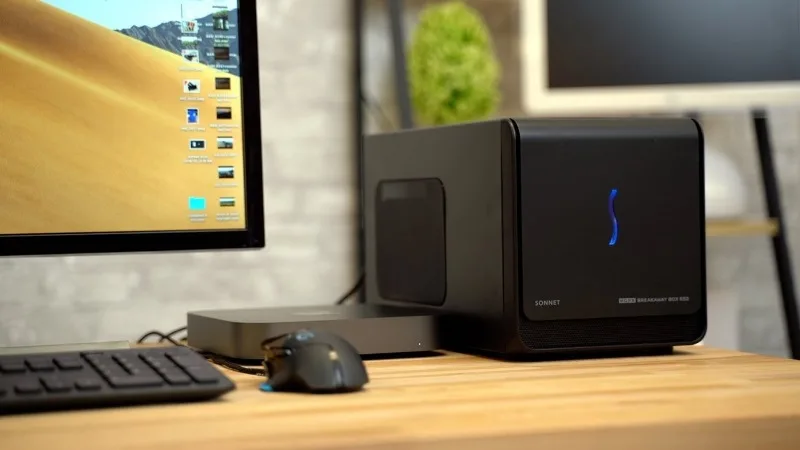
Apple’s transition to its own M-series processors for Mac computers brought numerous performance and efficiency benefits, but also created significant challenges around external graphics hardware compatibility. Unlike Intel-based Macs, connecting external graphics processing units (eGPUs) to Macs running Apple Silicon has been largely unsupported, limiting the ability for users to expand graphical power beyond the integrated GPU.
Recently, developers at TinyCorp have produced a new driver that enables Apple Silicon Macs to utilize external GPUs from both AMD and Nvidia. This innovation, now officially approved by Apple, marks an important step in expanding the capabilities of Mac computers with M-series chips.
While this new driver opens the door to external GPU support, there are important caveats. The driver is currently tailored specifically for artificial intelligence (AI) workloads and does not enhance traditional graphical performance or gaming capabilities. In other words, the external GPUs connected using this driver will assist in accelerating AI computations, such as machine learning tasks, rather than improving graphics rendering or general-purpose GPU compute.
The ability to leverage dedicated GPU accelerators for AI represents a significant opportunity for Mac users engaged in data science, AI research, and related computational fields. External GPUs can provide the additional resources necessary for demanding AI models without relying solely on the integrated GPU that comes with Apple Silicon.
Apple’s endorsement of the driver suggests their openness to expanding the functionality of M-series Macs, particularly in professional AI and machine learning environments. However, the company has yet to indicate if or when native external GPU support for broader graphics processing might be offered.
This development stems from the fact that Apple’s proprietary M-series architecture and macOS have historically had limited compatibility with external hardware acceleration, making this driver from TinyCorp a notable achievement. It effectively bridges the gap between Apple’s advanced silicon and the ecosystem of high-performance GPU hardware commonly used for intensive AI workloads.
At this stage, the new driver is expected to appeal primarily to developers, researchers, and professionals who require dedicated GPU acceleration for AI tasks on their Apple Silicon Macs. General users seeking GPU improvements for gaming, video editing, or other graphically intensive activities may not see immediate benefits from this solution.
Specific details on supported GPU models, driver installation, and performance benchmarks have not been broadly disclosed, leaving room for further information as the technology matures. Likewise, pricing and availability of the driver or related hardware configurations remain unspecified.
As Apple continues to evolve its hardware and software ecosystem, the introduction of this external GPU driver for AI workloads could pave the way for wider external graphics support and more flexible computational options on future Mac devices.
Apple Silicon Mac owners can now connect external AMD and Nvidia GPUs for AI processing with a new approved driver from TinyCorp.