App Store Sees Surge in New Apps Amid Growth of No-Code Platforms in Early 2026
July 21, 2026
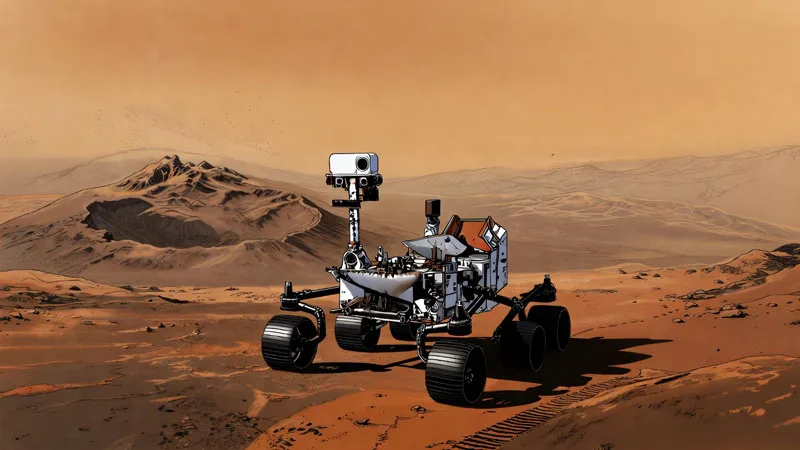
NASA’s Perseverance rover has marked a significant milestone by completing its first journeys on Mars based entirely on routes planned by artificial intelligence. These autonomous drives, conducted on December 8 and 10, 2025, took place within the Jezero Crater, a well-studied region on the Red Planet that has been the focus of ongoing scientific investigation for several years.
The use of AI to direct Perseverance’s movements represents a pioneering application of autonomous technology in planetary exploration. For the first time, the rover’s path was not determined by mission controllers on Earth but instead generated by an onboard AI system designed to assess the terrain and select the safest and most efficient route forward.
These AI-driven excursions demonstrated the ability of the rover to navigate the Martian surface with a high degree of autonomy, covering nearly 500 meters during the two separate drives. The feature is part of an experimental approach to enhance the rover’s capability to operate independently, reducing reliance on instructions sent from Earth and allowing more efficient use of mission time.
Such autonomy is crucial for future missions targeting more distant or challenging destinations in the solar system, where communication delays can impede timely decision-making. The success of the Perseverance rover’s AI navigation efforts is a step toward enabling spacecraft to perform complex tasks with minimal human intervention.
Jezero Crater remains a critical research site due to its unique geological formations and past presence of water, making it a rich area for studying Mars’ history and potential habitability. With AI technology assisting in navigation, Perseverance can more thoroughly investigate this terrain while minimizing risks during its travels.
While specific technical details or future plans for expanded autonomous drives were not disclosed, the recent missions highlighted by NASA underscore growing confidence in integrating artificial intelligence systems into robotic planetary explorers. This progress is expected to influence the design and operation of forthcoming missions dedicated to the exploration of Mars and other celestial bodies.
Increased autonomy not only enhances scientific productivity but also opens up possibilities for more complex and prolonged expeditions where direct human control is limited or impractical. The achievements of Perseverance’s AI-guided drives mark an important milestone in the evolution of space robotics and the exploration of extraterrestrial environments.
NASA’s Perseverance rover recently completed its first AI-driven drives on Mars, covering nearly half a kilometer autonomously in the Jezero Crater.