App Store Sees Surge in New Apps Amid Growth of No-Code Platforms in Early 2026
July 21, 2026
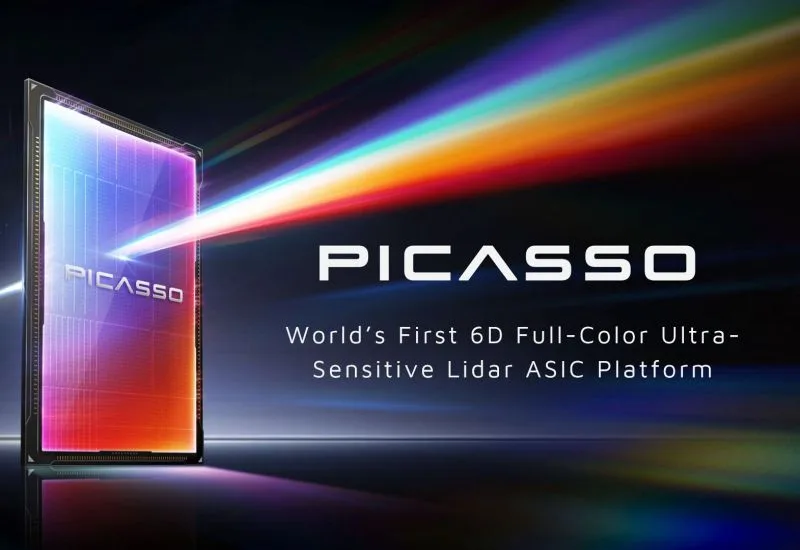
Hesai, a leading Chinese developer of lidar technology, has unveiled a new generation of lidar sensors that promises to bring color 3D vision to vehicles without relying on traditional cameras. This innovation could mark a significant advancement in the field of automotive perception systems, particularly for active driver assistance and autonomous driving applications.
Lidar, often described as an optical radar, uses laser pulses to measure distances and capture the shape of surrounding objects. This technology has become crucial in advanced driver assistance systems (ADAS) and self-driving cars as it provides highly accurate spatial awareness critical for safety and navigation.
Until now, lidar data has been predominantly monochromatic, generating point clouds that only depict objects in shades of gray based on the intensity of reflected laser signals. While effective for distance and shape detection, this lack of color information limits the sensor’s capability to distinguish object types or subtle surface features.
Hesai’s latest lidar model addresses this limitation by introducing color rendering into 3D point clouds. The new sensor captures more detailed data at a higher resolution, enabling it to create richer and more informative 3D representations of the environment in color. This advancement has the potential to improve scene understanding in demanding driving conditions.
By eliminating the need for additional cameras to achieve color imaging, Hesai’s solution could simplify sensor setups and reduce the complexity involved in sensor fusion onboard vehicles. This integration might enhance reliability and lower the costs associated with multi-sensor configurations currently used in many autonomous systems.
The industry has generally relied on fusing data from lidars and cameras to combine spatial precision with visual color information. Hesai’s innovation reflects a new direction where lidars themselves could provide a more comprehensive dataset, supporting better object classification and tracking.
While specific technical details, pricing, and availability of Hesai’s new lidar have not been publicly disclosed, the company’s announcement showcases the ongoing evolution of lidar technology in the automotive sector. As active driver assistance systems continue to advance, sensors delivering more detailed and meaningful environmental data will play a key role in improving vehicle safety and automation capabilities.
With this development, Hesai positions itself as a notable player driving the next wave of sensor improvements for intelligent vehicles, potentially influencing how automotive manufacturers integrate perception systems in the near future.
Chinese lidar maker Hesai introduces advanced sensor providing color 3D imagery and higher resolution for enhanced vehicle perception.