Russian Company Launches Second Batch of Satellites for Domestic Starlink Alternative
July 20, 2026
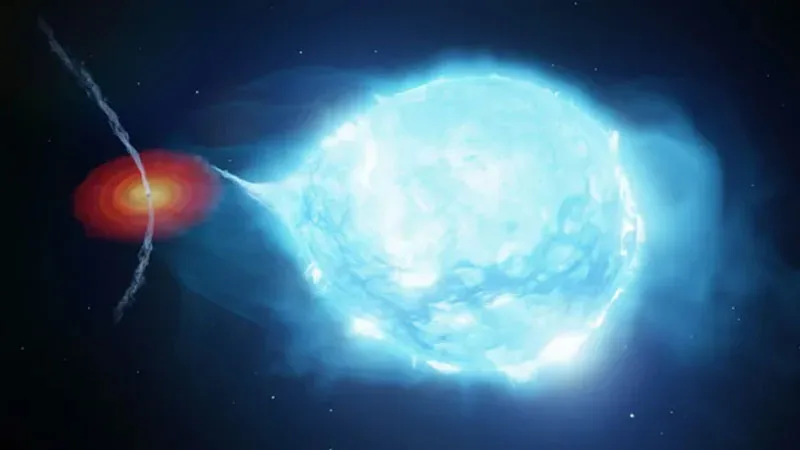
A recent breakthrough published in Nature Astronomy marks a significant advancement in the understanding of black hole dynamics and their influence on cosmic structures. Researchers have, for the first time, quantitatively determined the proportion of matter falling into a black hole that is emitted as energetic jets. This new insight allows scientists to more accurately estimate the power of jets generated by black holes of varying sizes, including the supermassive black holes that play crucial roles in shaping galaxy formation.
Black holes are known for their intense gravitational pull, which draws in surrounding matter. As this matter spirals inward, some of it is expelled at nearly the speed of light in the form of highly energetic jets. Understanding precisely how much of the infalling material converts into this jet radiation has long eluded astronomers due to observational challenges and the complexity of these extreme environments.
The study used detailed observational data combined with advanced theoretical modeling to quantify this conversion efficiency. Such measurements provide an essential tool for estimating jet power not only in smaller stellar-mass black holes but, crucially, also in supermassive black holes residing at the centers of galaxies. These supermassive black holes influence their host galaxies through feedback mechanisms driven by jet emissions, affecting galaxy growth and evolution over cosmic timescales.
By establishing a concrete relationship between accreting matter and jet energy output, astronomers now have a more solid basis to assess how black holes interact with their environment. This advancement promises to refine models of galactic development and improve predictions about the behavior of these enigmatic cosmic phenomena.
The implications extend beyond individual black holes, contributing to broader cosmological studies. Jets from supermassive black holes are known to regulate star formation and redistribute gas within galaxies, making the ability to measure jet power directly invaluable for understanding the lifecycle of galaxies.
Overall, this pioneering research opens new pathways for exploring the complex interplay between black holes and the universe at large, shedding light on fundamental processes that govern the structure and evolution of cosmic systems.
For the first time, scientists have quantified how much matter falling into black holes converts into jet radiation, improving galaxy evolution models.