Advancements in CFET Technology Promise Faster, Smaller, and More Reliable Semiconductor Transistors
July 21, 2026
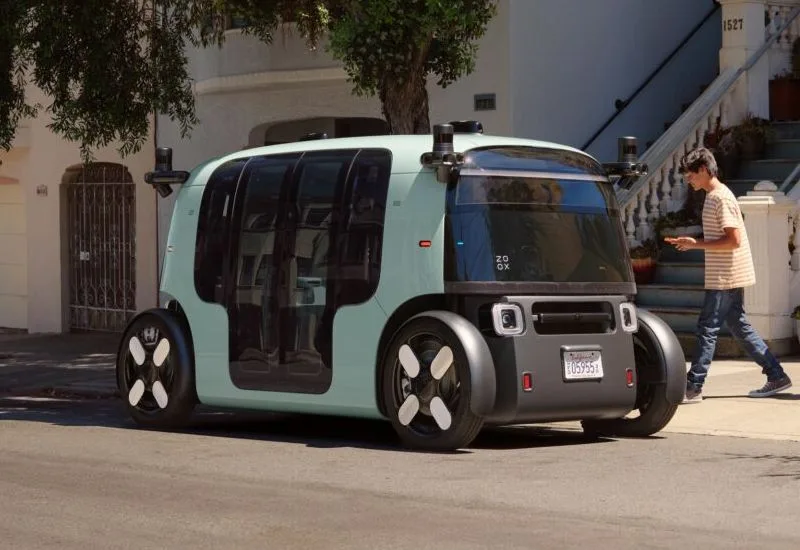
While most autonomous taxi prototypes currently operating in major global cities are conventional production vehicles retrofitted with additional sensors and control systems, startup Zoox has approached the challenge from a fundamentally different perspective. The company has developed a novel symmetrical design based on a parallelepiped shape, which it considers ideal for urban self-driving taxis.
Traditional self-driving taxi prototypes typically rely on existing car models adapted to host lidar, radar, cameras, and automated driving technology. However, these designs carry inherent limitations related to visibility, maneuverability, and passenger experience. Zoox’s solution involves creating a purpose-built autonomous vehicle with equal dimensions along its length and width, resembling a geometric parallelepiped—that is, a box-like, symmetrical form.
This shape provides several practical advantages. It improves spatial efficiency within urban environments by allowing the taxi to navigate tight streets and make sharper turns. The symmetrical design also removes the distinction between front and rear, enabling the vehicle to travel equally well in both directions without needing to turn around, which is beneficial for pick-ups and drop-offs in constrained city spaces.
Moreover, the parallelepiped form optimizes the placement of sensors and actuators. With a balanced layout, sensor coverage can be more uniform, enhancing the vehicle’s perception capabilities and overall safety. From a passenger perspective, the interior can be designed for a spacious and comfortable environment, with a focus on ease of entry and exit and possibly flexible seating arrangements.
While Zoox’s design departs from the retrofit approach common among many autonomous vehicle developers, it highlights a broader trend of rethinking vehicle architecture to meet the unique demands of robotaxi services. The startup’s innovative form factor could potentially influence the future of urban mobility, moving away from adapting legacy car designs toward dedicated autonomous vehicle platforms.
The company has been testing prototypes that embody this design philosophy, aiming to demonstrate the practical benefits of the parallelepiped shape in real-world city driving scenarios. Though details on commercial rollout and pricing remain undisclosed, Zoox’s approach underscores a growing emphasis on vehicle architecture as an integral factor in the evolution of autonomous mobility solutions.
Zoox adopts a symmetrical parallelepiped design for autonomous taxis, diverging from typical sensor-equipped production vehicle prototypes.