App Store Sees Surge in New Apps Amid Growth of No-Code Platforms in Early 2026
July 21, 2026
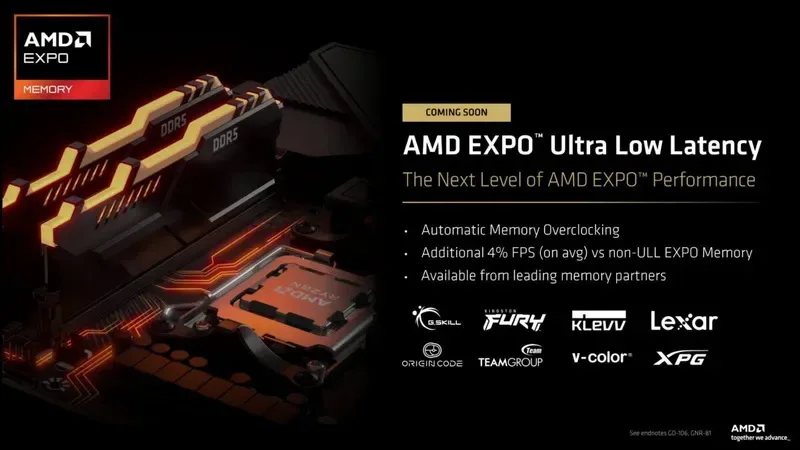
At Computex 2026, AMD unveiled additional insights into its recently announced EXPO Ultra Low Latency (EXPO ULL) technology, a feature designed to enhance gaming and computing performance through optimized DDR5 memory profiles. Initially, the announcement provided limited information on the technical underpinnings, but AMD executive David McAfee has since clarified the approach behind the system and its expected impact.
EXPO ULL builds upon AMD’s existing EXPO memory profiles, which simplify overclocking and memory tuning for DDR5 RAM modules. This new iteration focuses specifically on reducing memory latency while maintaining stability, leveraging specialized profiles to push memory timings beyond standard JEDEC specifications.
The goal is to facilitate a straightforward performance increase for end users without requiring complex manual tuning. According to AMD, the implementation of these refined profiles yields an average improvement in performance of approximately 13% compared to stock JEDEC standards. Furthermore, when benchmarked against current EXPO profiles, EXPO ULL demonstrates an additional 4% gain, highlighting its efficiency in extracting greater speed from existing memory hardware.
This boost translates into smoother gaming experiences and higher frame rates, effectively providing a free performance upgrade for systems utilizing DDR5 memory compatible with the new profiles. The technology aims to deliver these benefits without imposing additional cost or complexity on consumers.
David McAfee’s remarks suggested that the mechanism behind EXPO ULL is less intricate than initially anticipated. Rather than relying on radical architectural changes or exotic memory designs, the performance uplift is achieved through optimized profile settings tailored to reduce latency, indicating a pragmatic and accessible approach to memory enhancement.
By automating these improvements, AMD’s technology lowers the barrier for gamers and PC enthusiasts to achieve better responsiveness and frame rate stability. As DDR5 adoption continues to expand across both desktop and mobile platforms, advances of this nature play a critical role in extracting incremental but meaningful gains from memory subsystems.
While technical details about exact latencies and profile parameters have not been publicly disclosed, AMD’s disclosure at Computex signals a commitment to evolving the EXPO platform to meet the evolving demands of high-performance computing and gaming.
The introduction of EXPO ULL arrives at a time when the industry seeks effective methods to enhance system throughput without significant hardware upgrades. By leveraging memory tuning profiles that are simple to implement, AMD aims to align performance improvements with user convenience, potentially redefining the expectations surrounding DDR5 memory overclocking and optimization.
Further information, including availability and compatibility specifics, has yet to be announced. However, the early indicators suggest that EXPO Ultra Low Latency profiles will become an increasingly important feature for leveraging DDR5 modules on AMD-based systems going forward.
AMD reveals how its new EXPO Ultra Low Latency profiles deliver a simpler, free performance increase with DDR5 memory at Computex 2026.