
James Webb Telescope Reveals Atmospheric Asymmetry on Ultra-Hot Jupiter with Ruby and Sapphire Rain
June 16, 2026
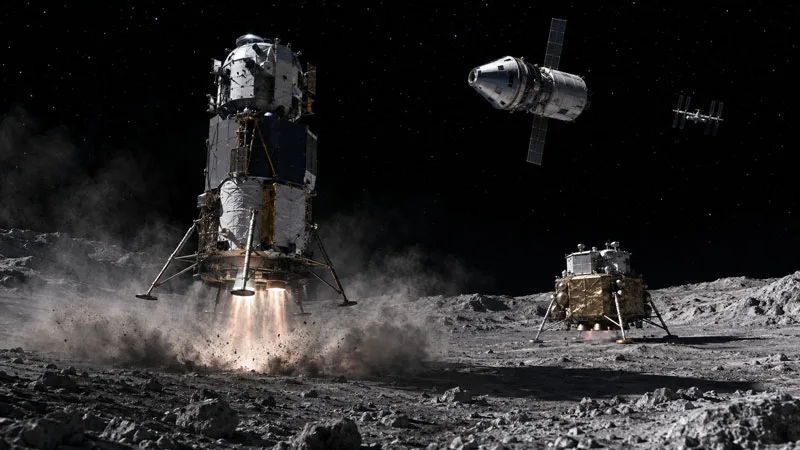
A recent article published in the Chinese journal Chinese Space Science and Technology presents a detailed discussion of lunar lander safety, spotlighting China’s advancements over past U.S. designs. Chinese engineers assert that their lunar module, known as Lanyue, offers a significantly higher degree of reliability and crew protection compared to American lunar modules developed during the Apollo era.
The analysis draws attention to the Apollo mission’s lunar lander, which featured a single ascent engine responsible for lifting astronauts off the lunar surface for their return to orbit. This design inherently carried risks, as any failure of the lone engine during ascent could have resulted in catastrophic consequences for the crew.
In contrast, the Chinese Lanyue module is engineered with multiple engines providing propulsion redundancy. This multi-engine configuration is designed to significantly reduce the probability of complete engine failure during ascent. By incorporating an array of engines, the system aims to ensure that even if one engine encounters problems, others can compensate to safely return the crew to lunar orbit.
The article positions this approach as a critical evolution in lunar spacecraft design, underscoring China’s commitment to enhancing mission safety. By addressing a known vulnerability in the historic Apollo hardware, the Lanyue lander concept represents a strategic effort to mitigate life-threatening risks inherent in lunar missions.
While the Apollo missions were historic milestones for space exploration, the single-engine design reflected technological and engineering limitations of the 1960s. Advances in propulsion systems and spacecraft architecture now allow for more robust and reliable landers tailored to crew safety.
Beyond engine redundancy, the discussion in the journal article reflects broader considerations for survival systems within lunar modules, although specific technical details on other safety features were not elaborated on in available summaries. The focus remains primarily on the critical aspect of ascent engine reliability.
This development comes amid ongoing global interest in renewed lunar exploration. As nations revisit plans for lunar surface missions, engineering solutions aimed at decreasing risks to astronauts are gaining heightened attention. China’s Lanyue module exemplifies this trend by incorporating multiple-engine redundancy to tackle a historically documented hazard.
Information about the timeline for constructing or deploying the Lanyue module has not been detailed. Similarly, comparisons to upcoming U.S. lunar landers remain speculative, as some American models are yet to be built or tested.
In summary, the Lanyue lunar module represents a noteworthy engineering milestone emphasizing crew survivability through a multi-engine ascent system. This approach seeks to rectify the single-engine vulnerability of earlier moon landers, potentially setting new standards for safety in future lunar exploration endeavors.
Chinese engineers highlight their Lanyue lunar module’s multiple-engine design as a safety improvement over one-engine Apollo modules.