ASUS Unveils Updated Zenbook Duo UX8407A Featuring Dual OLED Screens and Panther Lake Processor
June 23, 2026
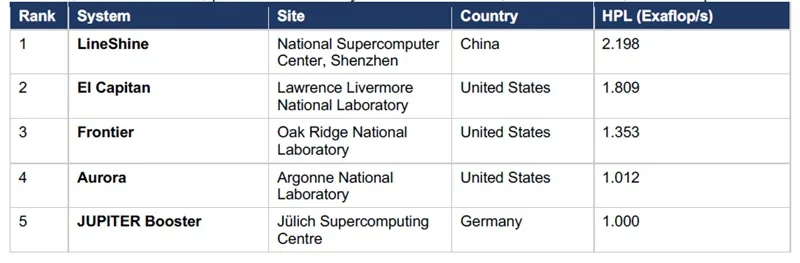
At the International Supercomputing Conference (ISC) 2026 held in Hamburg, Germany, the 67th edition of the TOP500 list of the world’s most powerful supercomputers was published, showcasing a significant shift in the global high-performance computing (HPC) landscape. The newly introduced Chinese supercomputer, LineShine, secured the top position, overtaking the United States’ El Capitan, which previously held the title of the fastest system worldwide.
LineShine’s rise to the summit of the TOP500 rankings marks a noteworthy milestone, especially considering it achieved this feat without relying on chips from prominent Western technology providers such as Nvidia, Intel, or AMD. This departure from conventional hardware suppliers highlights China’s advancing capabilities in developing and deploying indigenous processing technologies tailored for supercomputing tasks.
The TOP500 list ranks supercomputers based on their performance on the High Performance Linpack (HPL) benchmark, a widely accepted standard for measuring a system’s floating-point computing power. LineShine demonstrated superior results on this benchmark, solidifying its position as the most powerful supercomputer measured in the latest evaluation. While detailed specifications and architecture of LineShine have not been publicly disclosed, its success underscores a growing trend in HPC toward diversification of hardware ecosystems.
El Capitan, an advanced system located in the United States, had previously dominated the supercomputing scene with a sustained presence atop the TOP500 list. However, LineShine’s entry signals increasing competition between nations in the realm of extreme-scale computing, driven by national interests in scientific research, defense applications, and industrial innovation.
The ISC conference, known for spotlighting the cutting edge of computational science and engineering, serves as a barometer for advancements in HPC technology worldwide. The TOP500 list announcement attracts considerable attention from researchers, policymakers, and industry stakeholders seeking insight into the trajectory of supercomputing performance and strategy.
China’s accomplishment with LineShine may influence future directions for HPC development internationally, especially as countries look to reduce dependencies on foreign suppliers for critical technologies. The shift also raises questions about future collaborations and competitiveness in supercomputing research and manufacturing.
As computational demands continue to escalate across fields like climate modeling, artificial intelligence, and quantum chemistry, the evolution and diversification of supercomputing infrastructure will remain a key focus globally. LineShine’s debut atop the TOP500 list represents a pivotal moment in this ongoing evolution.
China’s LineShine debuts as the world’s fastest supercomputer, surpassing the US El Capitan at ISC 2026, without using Nvidia, Intel, or AMD processors.