Oracle’s Debt Challenges Threaten AI Data Center Project for OpenAI
July 21, 2026
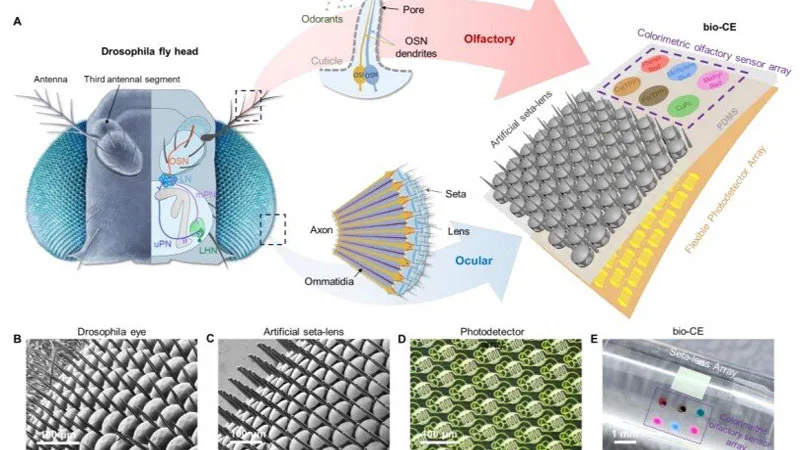
Researchers in China have introduced a groundbreaking visual sensor inspired by the anatomy of a fly’s eye, designed to advance the capabilities and miniaturization of drone technology. Although creating a fully spherical fly-eye sensor remains a challenge, the team has developed a highly compact flat sensor platform that mimics some of the insect’s visual advantages.
The new sensor measures approximately 1.5 by 1.5 millimeters, closely matching the size of the insect itself. This diminutive scale opens possibilities for the development of ultra-small drones comparable in size to flies or cockroaches. Such miniaturization marks a considerable departure from existing machine vision systems for drones, which tend to be larger, more complex, and require considerable power and computational resources.
What sets this sensor apart is not only its compact footprint but also its integrated olfactory functionality. Traditionally, visual systems in drones are focused solely on imaging and spatial awareness. The inclusion of scent detection capabilities suggests potential enhancements in environmental sensing and situational awareness, broadening the range of applications for micro drones in areas such as search and rescue, environmental monitoring, or hazardous material detection.
Although still in the research phase, this advancement demonstrates significant progress towards highly efficient, lightweight, and multifunctional sensory equipment for robotic platforms. The integration of panoramic vision with additional sensing modalities tackles long-standing limitations associated with drone size and energy consumption.
By reducing both the physical and computational footprint required for visual and olfactory perception, this work lays foundational technology for future drones capable of operating in complex environments while maintaining a minimal presence. The continued evolution of such compact sensors highlights the merging of biological inspiration with cutting-edge engineering to push the boundaries of what small-scale robotics can achieve.
Further development and refinement will be necessary to realize deployable systems, but this achievement signifies an important step toward versatile, insect-sized drones equipped with sophisticated sensory capabilities.
A new compact sensor mimicking fly eyes offers drones panoramic vision and built-in scent detection, advancing miniaturization and efficiency.