TrendForce Predicts Flash Memory Supply Shortage Will End in Late 2027
July 21, 2026
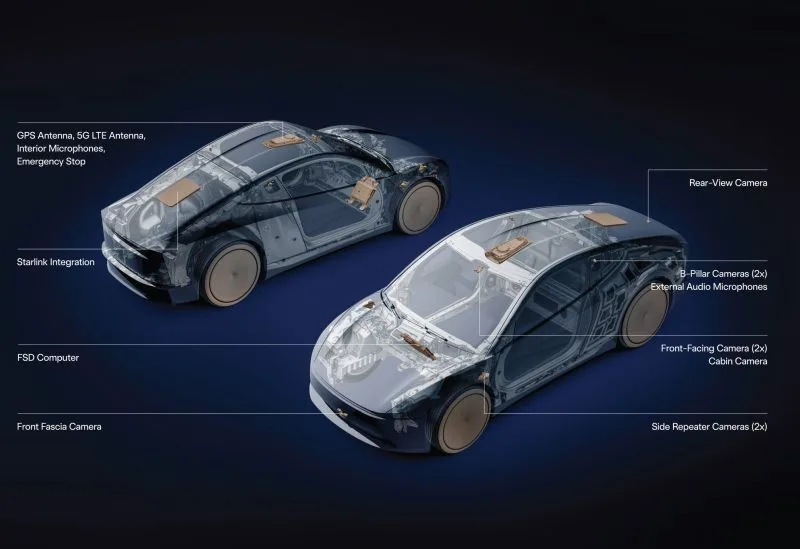
Tesla’s futuristic Cybercab has been found to include a satellite internet antenna provided by SpaceX’s Starlink service, a surprising addition considering the company’s autopilot system is designed to operate independently of external internet connectivity.
The autopilot technology powering Tesla’s vehicles is notable for its independence from highly precise digital maps and continuous online data streams. Instead of relying on external navigation aids or cloud-based processing, the system depends heavily on the vehicle’s onboard cameras. These cameras capture extensive visual data that is then interpreted by neural networks, allowing the autopilot to function based on real-time environmental recognition, much like a human’s visual perception.
Elon Musk, CEO of Tesla, has emphasized designing the autopilot to mimic human vision, enabling the car to make informed driving decisions using camera input alone. This architecture reduces dependency on internet connectivity, which is often seen as a potential weakness due to signal interruptions or delays.
Despite this offline-centric design philosophy, recent investigations into the Cybercab’s hardware revealed an embedded Starlink antenna. Starlink, SpaceX’s satellite-based internet system, is known for providing high-speed broadband access in areas with limited traditional network coverage.
The presence of the Starlink antenna within the Cybercab suggests Tesla may be planning additional functionalities that require dependable, high-bandwidth internet access. While the core autopilot system operates independently, other vehicle features or future updates might benefit from satellite internet connectivity, such as enhanced communication, data transfer, or remote management capabilities.
This integration points to Tesla’s broader vision of connected robotaxis that remain online and responsive, even in locations with poor terrestrial connectivity. Although specific uses for the Starlink connection within the Cybercab have not been disclosed, its inclusion signals potential innovation paths beyond fully autonomous driving based solely on onboard sensors.
As Tesla continues to develop its robotaxi concept and expand its autonomous driving technologies, the interplay between offline machine perception and constant connectivity remains an area to watch. The combination of neural network-driven autopilot and robust satellite internet access may improve Cybercab’s operational resilience, user experience, and service reach in the years ahead.
Tesla’s Cybercab features a Starlink satellite antenna even though its autopilot system primarily relies on onboard cameras and neural networks.