Oracle’s Debt Challenges Threaten AI Data Center Project for OpenAI
July 21, 2026
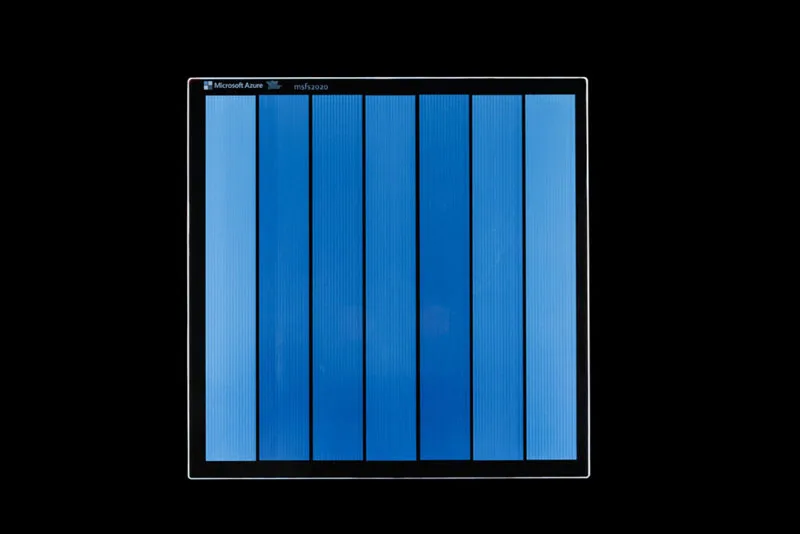
Microsoft is making a significant advancement in long-term data storage technology by enhancing its Project Silica initiative to utilize borosilicate glass for data encoding. This latest development marks an important step following years of research aimed at creating durable, environmentally resilient archival media capable of preserving information for millennia.
Initially, Project Silica focused on embedding data within thick quartz glass, a material known for its stability and resistance to harsh environmental factors. While quartz offers longevity, it comes with higher material costs and certain manufacturing challenges. The breakthrough now enables data to be recorded in borosilicate glass, commonly used in household glassware due to its thermal resistance and affordability.
Borosilicate glass is widely recognized in laboratory equipment and kitchenware for its durability under temperature variations, suggesting it could provide a more accessible and cost-effective medium for extensive data archival without compromising on longevity or data integrity. The adoption of this type of glass could facilitate broader practical applications for data preservation technologies.
Microsoft’s refined approach leverages the compound’s intrinsic properties to achieve a resilient data storage solution designed to withstand environmental stresses that would typically degrade conventional storage media over time. The glass cubes, or blocks, can hold substantial amounts of data—up to 1.5 terabytes within a faceted glass cube—while maintaining a compact physical footprint.
This capacity represents a considerable volume of information stored in a remarkably small and stable form factor, raising possibilities for future archival standards in industries requiring ultra-long-term data preservation, such as cultural heritage, government archives, and scientific data repositories.
The fundamental principle behind Project Silica involves encoding information using laser optics to create three-dimensional data layers within the glass matrix. This method ensures passive storage with no power required to maintain the data, and inherent resistance to electromagnetic interference, water damage, and temperature fluctuations.
With nearly a decade since the project’s inception, Microsoft’s transition to borosilicate glass indicates ongoing progress toward practical, durable, and scalable glass-based storage media poised for future use cases that demand longevity beyond current magnetic or electronic storage technologies.
Details regarding the commercialization timeline, pricing, or deployment models for the borosilicate glass data storage solution have not been disclosed. However, the material advances suggest a potential shift in archival data strategies, emphasizing physical resilience combined with high-density capacity.
This innovation aligns with broader industry movements exploring alternative archival storage media capable of surviving environmental extremes and obsolescence risks inherent in more common digital storage formats.
Microsoft refines its Project Silica tech to store data in borosilicate glass, enabling long-lasting archives with up to 1.5 TB capacity in a glass cube.