Honor Launches X7e Smartphone in Russia Featuring 7200mAh Battery and AI Shortcut Button
July 21, 2026
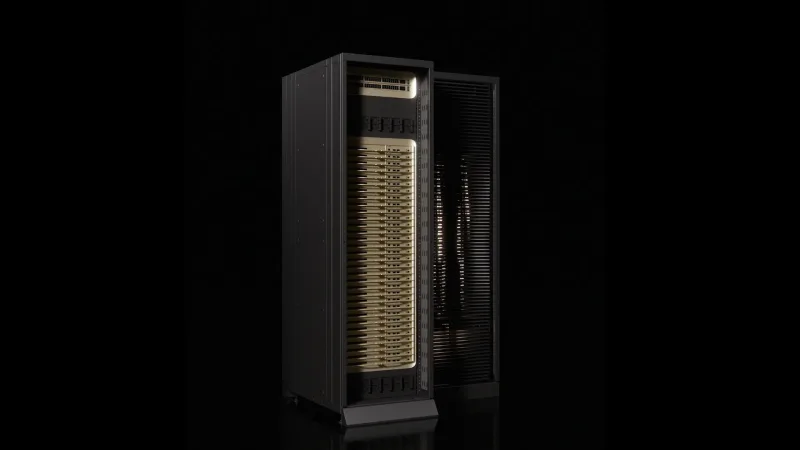
NVIDIA’s newly revealed Groq 3 chips represent a significant evolution in AI hardware design, diverging fundamentally from the company’s familiar AI accelerators. These Logic Processing Units (LPUs) embody a fresh architectural approach aimed at supporting the emerging needs of heterogenous, disaggregated AI platforms, particularly those tailored for agent-based artificial intelligence.
The Groq 3 series, including the LP30 and the LPX models, distinguishes itself by embracing a design philosophy centered on deterministic inference. Unlike conventional AI accelerators typically optimized for raw throughput or flexible training tasks, these LPUs prioritize predictable and consistent execution timing. This determinism in inference is crucial for complex AI applications requiring strict timing guarantees and reliable performance across heterogeneous computing environments.
One of the standout features of the Groq 3 LPUs lies in their use of SRAM and the strategic separation of components into a disaggregated architecture. This approach contrasts with monolithic AI accelerator designs, allowing the chips to integrate more flexibly within next-generation platforms where different processing elements and memory units can be combined in modular configurations. By leveraging such heterogeneity, NVIDIA aims to create a scalable ecosystem that meets the growing demand for agent-based AI—systems that operate autonomously and often require finely tuned and deterministic inference processes.
The departure from NVIDIA’s traditional AI accelerators is notable since past products typically followed more monolithic and aggregated architectures optimized for parallelized, high-volume AI workloads. In contrast, the Groq 3 chips, with their disaggregated design, strive to offer developers and system architects a new level of control and predictability. This can be especially beneficial in applications like robotics, autonomous agents, and real-time decision-making systems where timing and determinism play pivotal roles.
Although specific technical specifications and pricing details have not been publicly shared, the introduction of LPUs such as the LP30 and LPX signals NVIDIA’s strategic focus on expanding its AI hardware portfolio. By addressing gaps in its lineup, particularly for deterministic and agent-based AI platforms, NVIDIA positions itself to better address the diverse and evolving AI workload landscape.
In summary, NVIDIA’s Groq 3 LPUs highlight a notable innovation toward deterministic AI inference with disaggregated architecture and SRAM-centric design. This marks an important step in developing heterogeneous AI systems capable of supporting next-generation agent-oriented applications.
NVIDIA’s Groq 3 LPUs mark a departure from traditional AI accelerators, enabling deterministic inference for next-gen heterogeneous AI platforms.