Oracle’s Debt Challenges Threaten AI Data Center Project for OpenAI
July 21, 2026
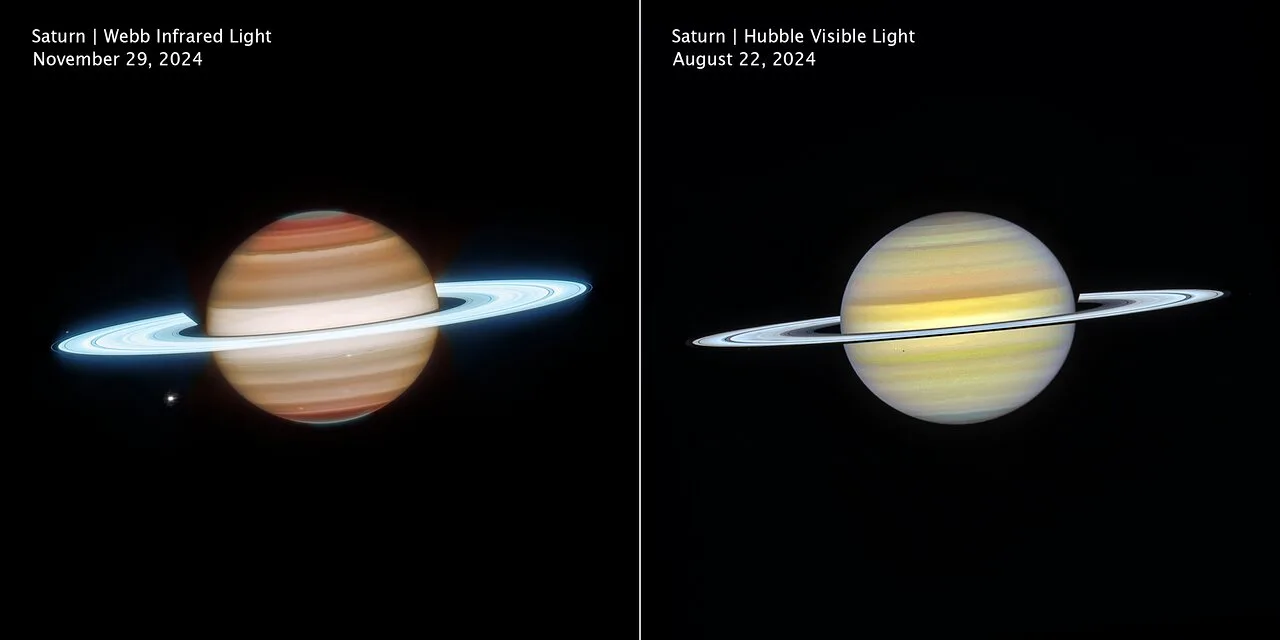
The European Space Agency (ESA) has presented the most extensive joint survey of Saturn ever obtained, leveraging the combined observational power of NASA’s Hubble Space Telescope and James Webb Space Telescope. These observations represent a milestone in planetary imaging, offering unprecedented detail of Saturn’s atmosphere during a significant seasonal transition.
In a coordinated effort conducted in August and November 2024, teams operating both the Hubble and James Webb telescopes gathered data across multiple wavelengths, encompassing visible light as well as infrared spectra. This dual approach has enabled researchers to examine Saturn’s atmosphere during its shift toward the 2025 equinox, a period that offers unique insight into the planet’s climatic and atmospheric dynamics.
Hubble’s capability in visible light complemented James Webb’s infrared observations, providing a comprehensive view that captures features invisible to either instrument alone. This synergy enhanced the clarity and resolution of Saturn’s atmospheric layers, rings, and weather phenomena.
The timing of the observations was particularly significant. As Saturn approaches equinox, its axial tilt adjusts the amount of sunlight reaching its northern and southern hemispheres, influencing atmospheric circulation patterns and seasonal changes. The data collected promises to improve understanding of these processes in gas giant planets.
The collaboration between the two telescopes also marks a significant achievement in space science, demonstrating how combining tools with different capabilities can yield deeper insights than isolated observations. By coordinating observations between Hubble, which has been instrumental in space exploration for over three decades, and the more recently launched James Webb telescope, scientists are pushing the boundaries of planetary research.
Further analysis of the combined datasets is expected to unveil new information about Saturn’s atmospheric composition, cloud dynamics, and ring system. This detailed imagery will serve as a valuable reference for future missions and planetary studies, helping to contextualize findings related to gas giant planets both within and beyond our solar system.
ESA’s release of these images underscores the importance of international cooperation in space science, leveraging assets from NASA and ESA-affiliated projects. The joint efforts exemplify the progress being made in exploring and understanding the intricate environments of our solar system’s outer planets.
ESA releases the most comprehensive images of Saturn to date, combining infrared and visible data from Hubble and James Webb telescopes.