
Thermalright Introduces Royal Pretor 130 Vision Cooler with Integrated 3.95-Inch Color Display
July 21, 2026
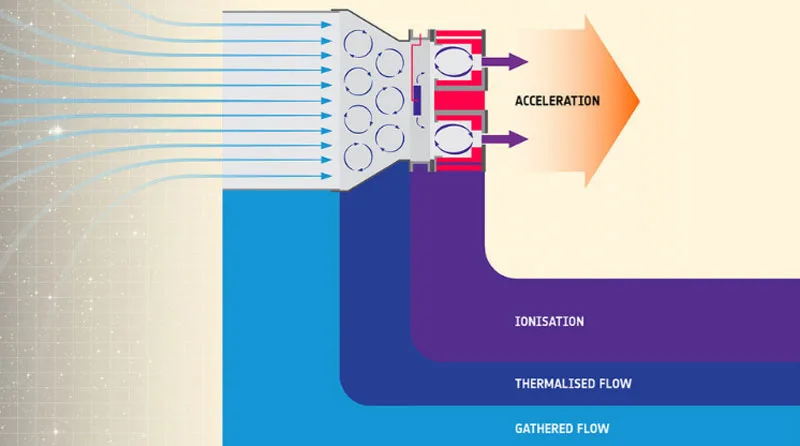
Satellites operating in low Earth orbit (LEO) commonly face the challenge of atmospheric drag, which slowly decreases their altitude over time. To counteract this effect, satellites use onboard fuel or inert gases such as xenon or krypton to power thrusters that correct their trajectory. However, once these fuel reserves are depleted, the operational lifespan of such satellites ends, and they eventually reenter the Earth’s atmosphere.
To address this limitation, a pioneering European initiative is developing satellite propulsion systems capable of continuously harvesting working gases from the Earth’s atmosphere. This innovative approach promises to significantly extend the operational duration of satellites in LEO by reducing reliance on finite onboard fuel supplies.
Traditional satellites in low Earth orbit encounter residual atmospheric particles that create drag, necessitating periodic orbit-raising maneuvers. These maneuvers consume valuable propellant, which is limited aboard the spacecraft. The depletion of these propellants currently marks the end of a satellite’s mission.
The new European project aims to circumvent this constraint by designing engines that draw working gas directly from the sparse atmosphere present in these orbital regions. This method involves capturing atmospheric gases and using them as propellant, thereby providing a continuous source of working fluid for the satellite’s thrusters.
By exploiting the very environment that hinders satellite operation, the technology turns a challenge into an advantage. Collecting atmospheric gases onboard could potentially maintain or increase orbital altitude for much longer periods than existing propulsion systems allow.
While detailed technical specifications and timelines for deployment have yet to be disclosed, this development signals an important evolution in space propulsion technology. Moving away from fixed propellant supplies toward atmospheric harvesting could transform the efficiency and longevity of satellites, impacting a wide range of applications from Earth observation to telecommunications.
This concept also aligns with broader goals of sustainability in space operations. Extending satellite lifespans reduces the frequency of satellite replacements and contributes to less orbital debris.
The European effort represents a significant step toward more sustainable and cost-effective satellite missions in low Earth orbit by harnessing the previously underutilized resources found in the planet’s upper atmosphere.
A European satellite initiative aims to extend low Earth orbit missions by using engines that extract working gas directly from the atmosphere.