Oracle’s Debt Challenges Threaten AI Data Center Project for OpenAI
July 21, 2026
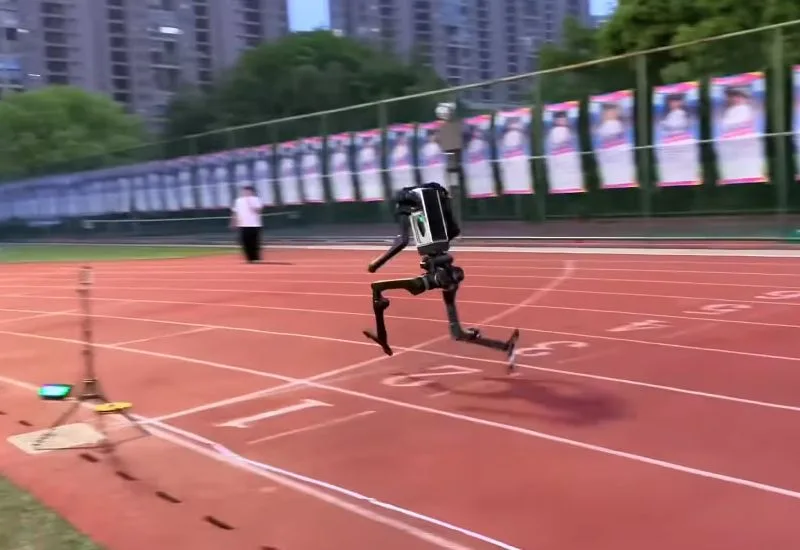
Efforts to enhance the physical capabilities of humanoid robots to rival those of their biological counterparts have accelerated in recent years, with running speed being a key area of focus. Various developers have staged trials aimed at either maximizing distance coverage or achieving higher velocities over short runs.
One notable advancement in this field comes from the Chinese robotics company Unitree, whose H1 model has demonstrated the ability to sprint at speeds of up to 36 kilometers per hour (approximately 10 meters per second). This achievement underlines ongoing progress in the development of robots capable of rapid and agile locomotion.
The H1’s performance was publicized as part of broader research efforts concentrating on closing the gap between robotic motion and human kinetics. Speed competitions and timed runs have become common benchmarks to illustrate a robot’s functional agility and endurance.
Reaching speeds of 36 km/h places the Unitree H1 among the faster humanoid robots, highlighting significant improvements in mechanics, control systems, and locomotion algorithms that support increased stability at high velocity.
While precise technical details and the extent of the H1’s capabilities beyond speed have not been extensively disclosed, its ability to reach such rapid pacing suggests it may have applications in fields where quick, nimble robotic movement is essential, including search and rescue, logistics, or surveillance scenarios.
Roboticists continue to explore approaches to refine humanoid mobility, gradually closing the performance gap with humans, and milestones like the Unitree H1’s sprint speed provide a glimpse into the future potential of autonomous, fast-moving machines.
The Unitree H1 robot achieved a running speed of 36 km/h, showcasing advancements in humanoid robotic mobility.