
Honor Launches X7e Smartphone in Russia Featuring 7200mAh Battery and AI Shortcut Button
July 21, 2026
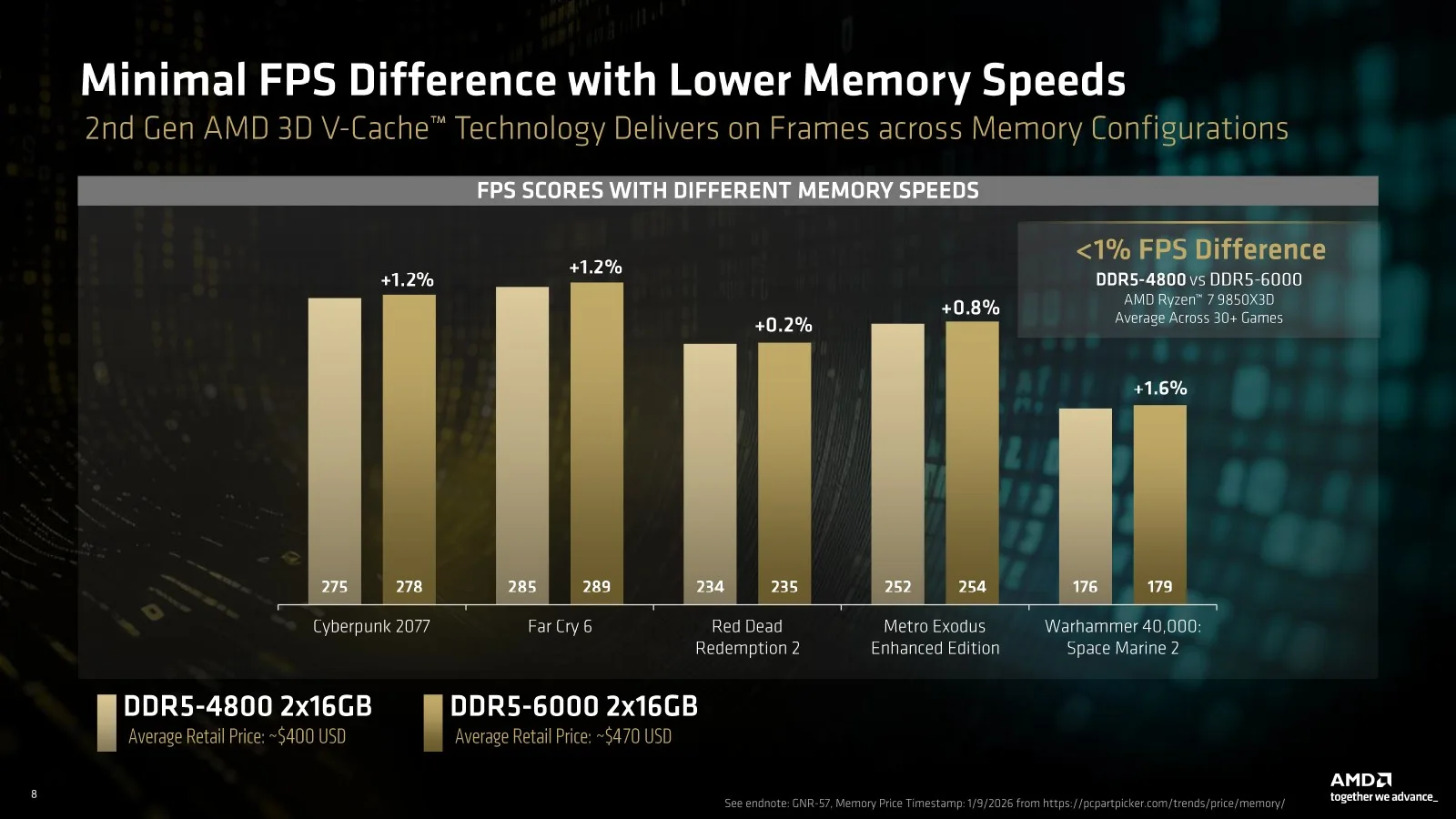
As DDR5 memory prices continue to fluctuate, PC builders and gamers face the challenge of balancing cost and performance when choosing RAM for AMD Ryzen processors, particularly the Ryzen X3D series. AMD suggests that with these processors, it is possible to economize on memory purchases without sacrificing performance. This guidance has garnered attention amid the relatively high prices of DDR5 modules.
To verify AMD’s claims, a recent evaluation compared five budget-friendly DDR5 memory kits at speeds of 4800, 5200, and 5600 MT/s against a premium DDR5-6000 CL26 kit, which is widely regarded as the optimal choice for Ryzen CPUs. The goal was to determine whether cheaper memory could deliver comparable performance and what trade-offs might exist.
The tested budget kits encompass a range of speeds below the 6000 MT/s threshold and involve higher latency values relative to the premium kit. Since memory speed and latency significantly influence Ryzen performance due to the processor architecture’s sensitivity to memory subsystem efficiency, the study aimed to find tangible performance differences in real-world scenarios.
Results revealed that while the top-tier DDR5-6000 CL26 kit consistently provided superior throughput and lower latency, the impact on overall system performance with Ryzen X3D processors was less pronounced than one might expect. Several of the lower-speed DDR5 kits performed close enough to the premium option in gaming and common productivity workloads, suggesting that cost savings on memory can be achieved without a substantial compromise in everyday use.
This finding aligns with AMD’s assertion that Ryzen X3D processors can tolerate some memory performance reduction without a major degradation in system responsiveness or frame rates in gaming. However, the differences became more visible under certain benchmarking and synthetic load testing conditions, indicating that enthusiasts aiming for maximum performance might still prefer the faster, lower latency memory.
Ultimately, the analysis supports the idea that buyers looking to build cost-effective Ryzen systems can consider more affordable DDR5 kits in the 4800 to 5600 MT/s range without fearing significant performance losses. For users whose workloads are extremely latency or bandwidth sensitive, investing in premium DDR5-6000 CL26 memory remains a valid choice.
As DDR5 continues to mature and prices evolve, this comparison offers a practical perspective for users weighing the benefits and costs of current memory options when paired with the latest Ryzen processors.
A recent analysis compares budget DDR5 kits to premium DDR5-6000 CL26 for Ryzen processors to assess performance and cost-effectiveness.