
Oracle’s Debt Challenges Threaten AI Data Center Project for OpenAI
July 21, 2026
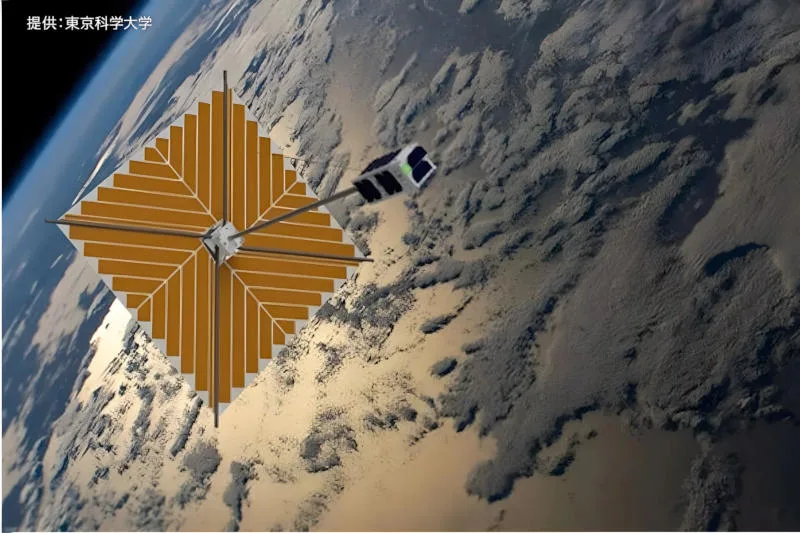
On April 23, 2026, Japan’s Aerospace Exploration Agency (JAXA) successfully launched a fleet of eight small satellites as part of the Kakushin Rising mission. The launch was supported by private aerospace contractor Rocket Lab, marking a significant collaboration between public and private sectors in advancing space technology.
Among the payload was the OrigamiSat-2 CubeSat, an innovative spacecraft that demonstrated a remarkable transformation once in orbit. Designed to expand dramatically after deployment, the OrigamiSat-2 unfolded and increased its size by a factor of 25 while operating in space.
The OrigamiSat-2 represents a new approach to CubeSat design, emphasizing compact launch dimensions combined with significant post-launch physical growth. This capability allows for enhanced mission capabilities while minimizing volume constraints during the launch phase.
JAXA’s deployment of this CubeSat validates critical technologies related to in-orbit expansion mechanisms, which could lead to more versatile satellite designs in the future. The expanded structure of OrigamiSat-2 potentially accommodates larger sensors, antennas, or solar panels than typically possible on small satellites.
The mission demonstrates how small satellites can leverage innovative engineering solutions to maximize their utility and impact in space exploration and observation. By successfully increasing its size by 25 times, OrigamiSat-2 sets a precedent for future compact spacecraft that can deploy larger configurations once in orbit.
The broader Kakushin Rising mission, encompassing eight small satellites launched together, reflects growing efforts in Japan to foster advances in space technology and satellite development. Partnering with Rocket Lab facilitated access to a reliable launch platform capable of deploying multiple nanosatellites efficiently.
While detailed information about the specific instruments aboard OrigamiSat-2 or the other satellites has not been publicly disclosed, the successful expansion of the CubeSat highlights innovative trends in satellite miniaturization combined with deployable structures. Such advancements are crucial as space missions increasingly demand smaller, more versatile, and cost-effective instruments for scientific, commercial, and technological purposes.
The use of origami-inspired design principles in spacecraft engineering continues to gain traction, allowing engineers to create compact packages that can expand in orbit to provide increased surface area or volume. OrigamiSat-2’s accomplishment marks a noteworthy milestone in demonstrating these concepts operationally.
With the increasing accessibility of space through collaborations between government agencies and private companies, technologies like those demonstrated by the OrigamiSat-2 CubeSat are likely to influence future satellite missions. These innovations could enhance communications, Earth observation, space science, and other applications requiring deployable satellite structures.
As global investment in small satellite launches continues to grow, successful deployments like OrigamiSat-2 reinforce the significant potential of nanosatellite platforms to deliver new capabilities despite their size. Such missions underscore ongoing efforts to rethink satellite design, pushing the boundaries of what small spacecraft can achieve once in orbit.
Japan’s OrigamiSat-2 CubeSat deployed and grew 25 times its original size after launch during the Kakushin Rising mission.