Oracle’s Debt Challenges Threaten AI Data Center Project for OpenAI
July 21, 2026
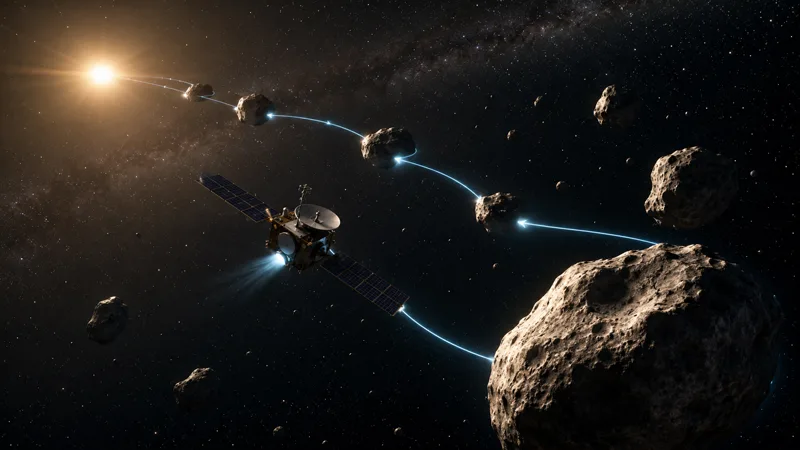
Addressing one of the most intricate problems in space mission planning, researchers have devised a novel solution to optimize spacecraft routes when visiting multiple asteroids while minimizing fuel consumption. This advancement tackles significant challenges posed by the dynamic nature of asteroid trajectories in the solar system.
The problem draws parallels to the well-known traveling salesman problem (TSP), which involves finding the shortest route that visits various locations and returns to the starting point. However, unlike typical TSP scenarios where destinations are fixed, asteroids continuously move along complex and often unpredictable orbits. This motion substantially increases the complexity of plotting efficient space expeditions.
Planning spacecraft journeys to several asteroids requires accounting for their constantly changing positions and velocities. The conventional strategies for route optimization fall short since they generally assume static target locations. In space, mission planners must consider not only the distances between asteroids but also timing constraints and orbital mechanics affecting fuel usage.
Fuel efficiency is paramount because spacecraft have limited reserves. Excess consumption can jeopardize mission success or prevent the craft from completing its planned itinerary. Therefore, minimizing propellant waste while ensuring all target asteroids can be visited is a critical challenge.
The newly developed approach integrates advanced mathematical models and computational techniques to evaluate potential trajectories across multiple moving objects. By simulating the orbits and relative motions of asteroids, this method identifies pathways that require the least amount of fuel for a spacecraft to visit all selected bodies.
This progress holds promising implications for future asteroid exploration missions. With improved route optimization, space agencies can maximize scientific return by reaching more targets within a single mission, reducing costs, and enhancing mission feasibility. Such capabilities are particularly vital as interest in asteroid mining and planetary defense increases.
While the specifics regarding the implementation and testing of this solution remain to be detailed, its introduction marks a significant step forward in cosmic logistics. Efficiently navigating the ever-shifting asteroid belt could unlock new opportunities for exploration and utilization of these celestial objects.
Overall, this breakthrough underscores the importance of solving complex logistical problems using innovative approaches that consider real-time dynamics rather than static assumptions. As space missions become more ambitious, similar challenges will demand equally sophisticated planning methods.
Researchers solve the complex challenge of planning multi-asteroid missions with minimal fuel by accounting for their dynamic orbits.