
Realme Launches C100x in Russia Featuring 8000mAh Battery at Competitive Price
June 30, 2026
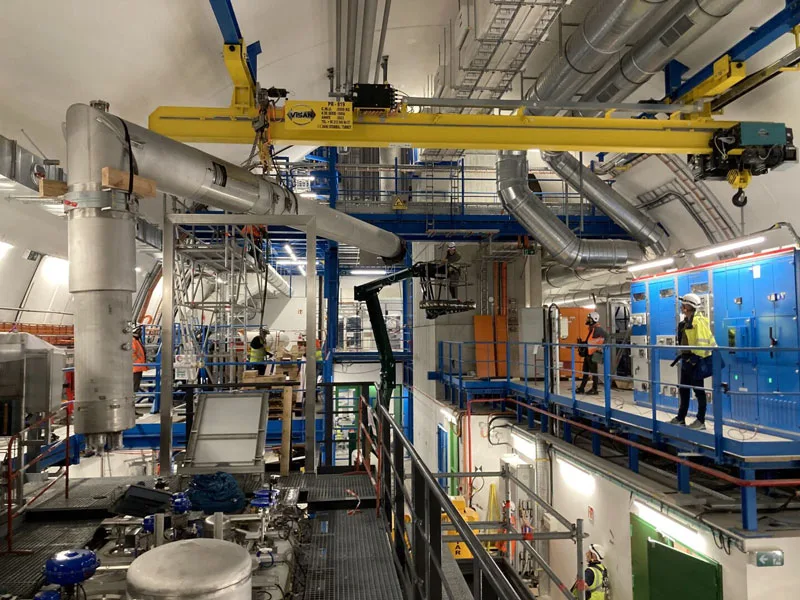
The European Organization for Nuclear Research (CERN) has announced a significant pause in operations of the Large Hadron Collider (LHC), initiating a four-year shutdown to carry out the most extensive upgrade in the facility’s history.
This long-term suspension marks the beginning of the third major modernization phase for the LHC. Upon completion, expected by 2030, the upgraded accelerator will be renamed the High-Luminosity Large Hadron Collider (HL-LHC). This transformation aims to significantly enhance the collider’s capacity to generate and collect collision data.
The HL-LHC will enable scientists to conduct experiments with higher precision and greater statistical power, improving the understanding of fundamental particles and forces shaping the universe. The increased luminosity translates into a larger number of particle collisions per second, creating opportunities for discoveries beyond current limitations.
The ongoing upgrade reflects CERN’s commitment to maintaining its position at the forefront of particle physics research. By amplifying the collider’s performance, the HL-LHC will support experiments that probe deeper into the structure of matter, ultimately contributing to advances in theoretical models and supporting a broad array of scientific inquiries.
While the specific technical details and advancements involved in this overhaul have not been fully disclosed, the scale of the project underlines a leap in collider technology and experimental capability. This extensive downtime indicates the complexity of the processes required to install upgrades and ensure safety and precision in subsequent operations.
As CERN undertakes this ambitious enhancement, the global scientific community anticipates the new possibilities the HL-LHC will unlock, reinforcing CERN’s role as a leader in exploring the fundamental questions of physics.
CERN halts the Large Hadron Collider for four years to perform its largest upgrade, transitioning to the High-Luminosity LHC by 2030.