Collision with a Dwarf Galaxy Tilted the Milky Way’s Disk by Over 90 Degrees, Researchers Find
July 24, 2026
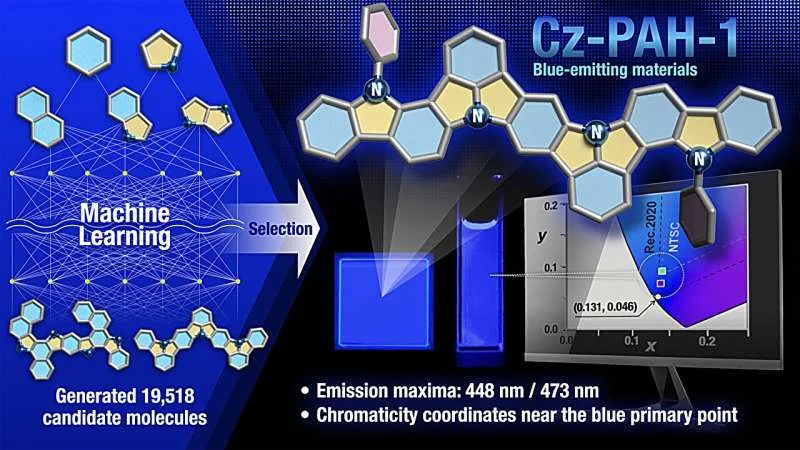
Advancements in display technology are poised to benefit significantly from artificial intelligence, as recent machine learning efforts have led to the discovery of new materials designed to improve blue organic light-emitting diodes (OLEDs). Blue OLED pixels are crucial for high-quality displays but have historically faced challenges related to efficiency and lifespan compared to their red and green counterparts.
Blue OLEDs operate under demanding conditions, requiring higher excitation energies, which has limited their performance. These limitations have made it difficult to achieve bright, energy-efficient, and long-lasting blue pixels using traditional organic materials.
By leveraging machine learning techniques, researchers have been able to bypass some of the time-consuming and costly conventional computational methods typically involved in materials research. AI algorithms facilitated an intelligent search for promising organic compounds that can serve as blue OLED emitters, focusing on attributes such as brightness, energy efficiency, and manufacturability.
The impact of this AI-assisted discovery is far-reaching. Finding suitable materials that combine high performance with accessibility in production could address one of the major bottlenecks in OLED technology—the creation of effective blue light emitters. Such materials are expected to contribute to enhanced display quality, better energy consumption profiles, and potentially lower manufacturing costs.
This development highlights the growing intersection of artificial intelligence and materials science, where machine learning is becoming a pivotal tool in advancing next-generation electronic components. While specifics on the newly identified compounds and their commercial timelines remain undisclosed, this approach underscores a promising pathway to overcoming longstanding challenges in OLED technology.
As display manufacturers seek to meet the demand for vivid and efficient screens across consumer electronics—from smartphones to televisions—innovations in blue OLED materials driven by AI could offer a competitive edge, pushing the boundaries of what organic light-emitting technologies can achieve.
AI-driven research identifies new materials for blue OLEDs, enhancing brightness, efficiency, and production affordability.