Advancements in CFET Technology Promise Faster, Smaller, and More Reliable Semiconductor Transistors
July 21, 2026
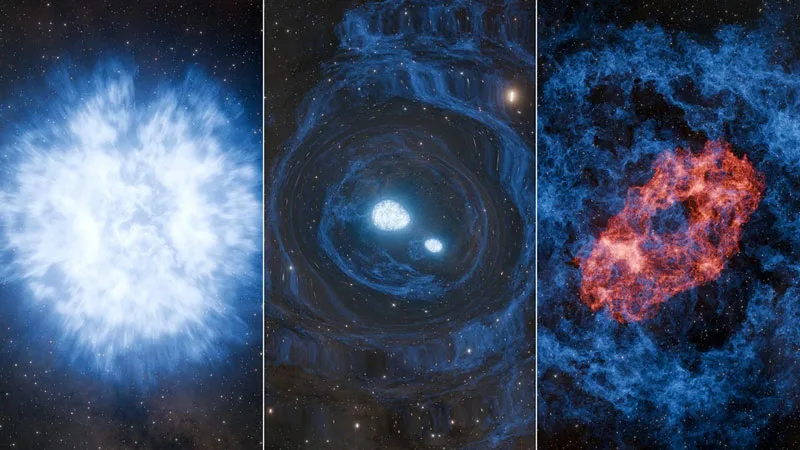
In August 2025, astronomers observed a cosmic event that may represent an unprecedented category of stellar explosion. This phenomenon, designated AT2025ulz, appears to merge characteristics of two powerful astrophysical events: a supernova and a kilonova.
While supernovae—the explosive deaths of massive stars—are relatively well understood, kilonovae are far rarer. The first confirmed kilonova was only recorded once before, in 2017. Consequently, scientists expected to identify more events consistent with kilonovae over time. Instead, this latest observation has introduced complexities that defy conventional classification.
The newly detected explosion demonstrated features that could not be fully explained by existing models for either supernovae or kilonovae. Due to this, researchers have tentatively coined the term “superkilnova” to describe this hybrid event.
Details about the exact physical processes underlying the superkilnova remain uncertain. The event challenges established theoretical frameworks related to stellar explosions and the resultant cosmic phenomena. This has spurred astrophysicists to reconsider their understanding of how massive stellar bodies can end their life cycles and generate complex energetic emissions in space.
The discovery underscores the dynamic and evolving nature of space science. Each new observation can expand horizons, stimulating revisions or entirely new theories about fundamental cosmic mechanisms. As observational technologies advance, further study of AT2025ulz and similar events will be crucial to grasp their role in cosmic evolution.
While detailed data regarding the explosion’s exact measurements and aftermath have not been extensively disclosed, the implication is clear: the universe still holds many secrets, some of which emerge unexpectedly, reshaping scientific exploration.
A cosmic explosion observed in 2025 challenges known categories, prompting the proposal of a new theory in astrophysics.