App Store Sees Surge in New Apps Amid Growth of No-Code Platforms in Early 2026
July 21, 2026
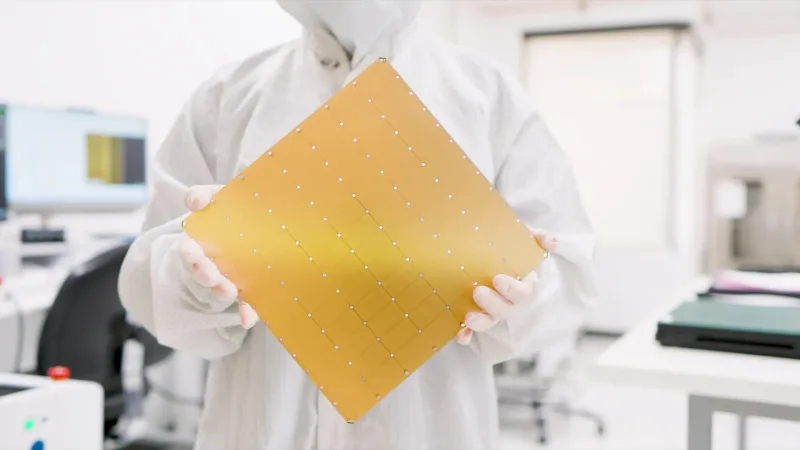
In the realm of computing hardware, Cerebras Systems has developed some of the largest AI processors in existence, notable for their immense size and specialized design. These wafers-scale chips, comparable to an entire 300-millimeter silicon wafer trimmed to a square with a diagonal matching the wafer’s diameter, have gained traction in practical applications over recent years.
Unlike legendary Russian artifacts such as the Tsar Cannon and Tsar Bell, which never fulfilled their intended functions, Cerebras’ massive chips are actively utilized in computing environments. Their architecture caters specifically to artificial intelligence workloads, leveraging the vast on-chip area to enable parallel processing capabilities that far exceed conventional designs.
Wafer-scale integration breaks traditional semiconductor conventions by using almost the entire silicon wafer as a single chip, drastically increasing the number of processing cores and memory available on one piece of hardware. This design is aimed at accelerating machine learning models, enabling faster training and inference times by widely distributing computing tasks.
Despite these advantages, Cerebras’ colossal processors have not yet displaced standard server CPUs in most data centers. While they provide remarkable performance benefits for AI workloads, classic processors remain indispensable for general-purpose computing, system management, and workloads that do not require customized chip structures.
Industry observers continue to monitor how wafer-scale technology evolves and impacts the balance between specialized hardware and traditional systems. Efforts to integrate such chips into broader infrastructure highlight the ongoing transition in computing paradigms driven by ever-growing AI demands.
In summary, Cerebras’ wafer-scale chips stand as a testament to innovation in chip fabrication and AI optimization, already proving their practical worth. Nonetheless, the shift away from conventional server processors remains incomplete as data centers balance performance, flexibility, and cost.
Cerebras’ massive AI chips, nearly the size of a full wafer, demonstrate real-world use but have yet to supplant conventional server CPUs.