App Store Sees Surge in New Apps Amid Growth of No-Code Platforms in Early 2026
July 21, 2026
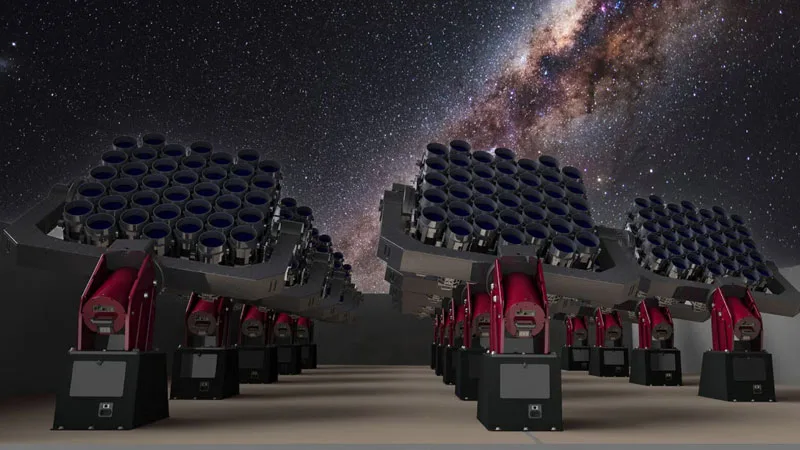
A novel telescope set to be constructed in Chile will combine more than a thousand Canon telephoto lenses to conduct the first comprehensive mapping of the cosmic web. This ambitious project aims to revolutionize astronomical observations by assembling 1,140 individual lenses into one extensive camera array.
The telescope will not rely on a single massive lens but instead utilize a collection of 1,140 telephoto lenses grouped in clusters of 38. Although the concept of multiple lens arrangements has been explored before, this is poised to be the first telescope fully composed of individual lenses that together simulate an effective aperture diameter of approximately 4.8 meters.
Each lens contributes its own image data, enhancing the overall sensitivity and resolution of the instrument. This modular approach allows for high precision in capturing astronomical phenomena, particularly beneficial for analyzing the cosmic web—the vast and intricate network of matter that structures the universe.
The design draws inspiration from a unique source—a monster moth character named Mothra, created in Japan in the 1960s for the Godzilla film universe. The multitude of lenses resembles the insect’s many eyes, reflecting the project’s goal of wide and detailed sky coverage.
By combining numerous lenses, the telescope can survey large portions of the sky with unprecedented detail. This capability is expected to provide new insights into the distribution of galaxies, dark matter, and the fundamental architecture of the cosmos.
Although details regarding the full specifications and timeline remain limited, the telescope’s assembly in Chile—a region favored for its clear skies and low atmospheric disturbances—positions it well for significant contributions to astronomical research.
This project exemplifies a trend toward innovative optical technologies in astronomy, leveraging existing commercial hardware in novel ways to overcome traditional limitations in telescope design. The undertaking holds promise not only for mapping cosmic structures but also for advancing methods in astronomical instrumentation and sky surveys.
A new telescope with 1,140 Canon telephoto lenses will enable the first large-scale mapping of the cosmic web from Chile.