App Store Sees Surge in New Apps Amid Growth of No-Code Platforms in Early 2026
July 21, 2026
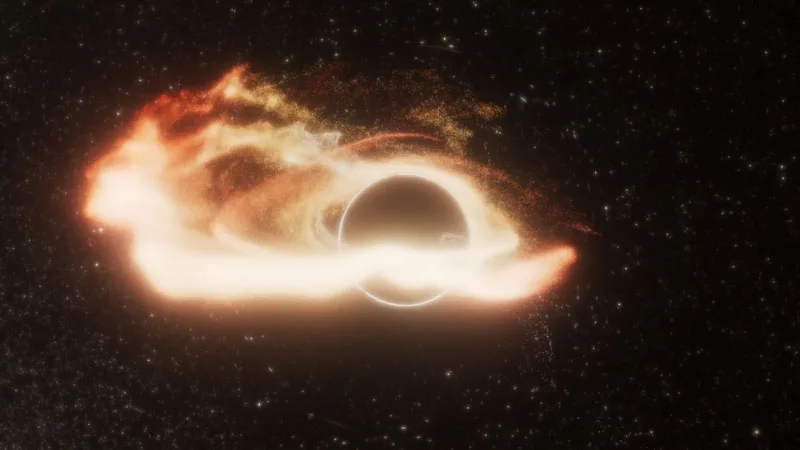
On July 2, 2025, China’s space-based X-ray observatory known as the Einstein Probe identified an extraordinary and rapidly fluctuating X-ray flash designated EP250702a. Originating from a distant galaxy approximately eight billion light-years away, this phenomenon ranks among the most intense X-ray outbursts ever recorded.
The significance of this discovery lies not only in the intensity of the X-ray emission but also in its interpretation. Analysis suggests the flare was generated by a rare intermediate-mass black hole, a class of black holes whose existence has been elusive until recently. Unlike the more commonly studied stellar-mass and supermassive black holes, these intermediate-mass variants fall in the mass gap and provide crucial insights into black hole formation and evolution.
The observed event appears to have been triggered by the black hole tearing apart a white dwarf star. The tidal disruption of such a dense, compact stellar remnant results in a highly energetic release of X-rays as the stellar material is accreted onto the black hole. This process offers a unique opportunity to study the behavior and properties of intermediate-mass black holes, which are challenging to detect due to their rarity and the subtlety of their observational signatures.
The Einstein Probe’s detection highlights the increasing capabilities of spaceborne X-ray telescopes to monitor transient cosmic phenomena with high sensitivity and temporal resolution. This breakthrough enriches the understanding of black hole demographics across the universe and the dynamic processes occurring in distant galaxies.
Further studies based on EP250702a and similar events are expected to refine current models of black hole growth and the fate of stars in extreme gravitational environments. As observational technology advances, astronomers anticipate uncovering more examples of these rare astrophysical phenomena, deepening knowledge about the complex lifecycle of stars and black holes.
The Einstein Probe captured a powerful X-ray flare revealing an elusive intermediate-mass black hole shredding a white dwarf star.