Advancements in CFET Technology Promise Faster, Smaller, and More Reliable Semiconductor Transistors
July 21, 2026
Google Quantum AI has announced a significant expansion in its quantum computing research by integrating a new platform based on neutral atoms alongside its existing superconducting qubit program. This development represents a strategic move towards building hybrid quantum computers that leverage the strengths of both quantum technologies.
For several years, Google’s quantum computing efforts have predominantly focused on superconducting qubits, a technology that employs circuits cooled to near absolute zero to exhibit quantum mechanical behaviors. These qubits have been central to many recent advances, including demonstrations of quantum supremacy and error correction milestones.
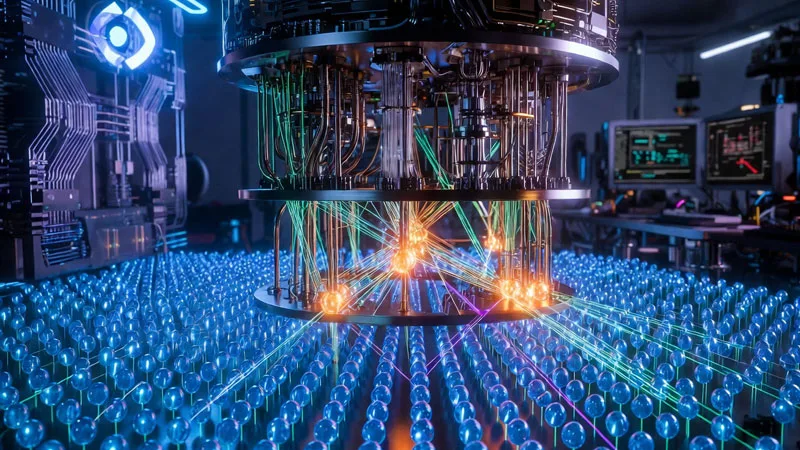
However, Google is now complementing this approach by incorporating neutral atom quantum computing into its portfolio. Neutral atom quantum processors manipulate individual atoms held in place by laser light to encode qubits, offering distinct advantages such as scalability and long coherence times. This method provides a contrasting set of capabilities compared to superconducting circuits.
The company aims to connect these two quantum platforms, constructing hybrid quantum systems that combine the best characteristics of superconducting and neutral atom technologies. By doing so, Google hopes to enhance computational power, qubit connectivity, and operational flexibility beyond what each technology can achieve on its own.
The hybrid quantum approach could enable more complex quantum operations and broaden the practical applications of quantum machines. The integration of different qubit types also poses unique challenges, requiring sophisticated control and error mitigation techniques to maintain quantum coherence across heterogeneous systems.
While specific technical details and timelines for the hybrid quantum computer development have not been disclosed, this move highlights Google’s commitment to pioneering diverse quantum architectures. The company’s broader research initiative seeks to accelerate the path toward fault-tolerant quantum computing and unlock new possibilities in fields such as materials science, cryptography, and complex system simulations.
As the landscape of quantum computing evolves rapidly, combining superconducting qubits with neutral atom systems may represent a promising roadmap. By exploring this hybrid model, Google Quantum AI continues to position itself at the forefront of next-generation quantum technology innovation.
Google Quantum AI expands its research with a new neutral atom platform, aiming for hybrid quantum computers blending two leading quantum techs.