Advancements in CFET Technology Promise Faster, Smaller, and More Reliable Semiconductor Transistors
July 21, 2026
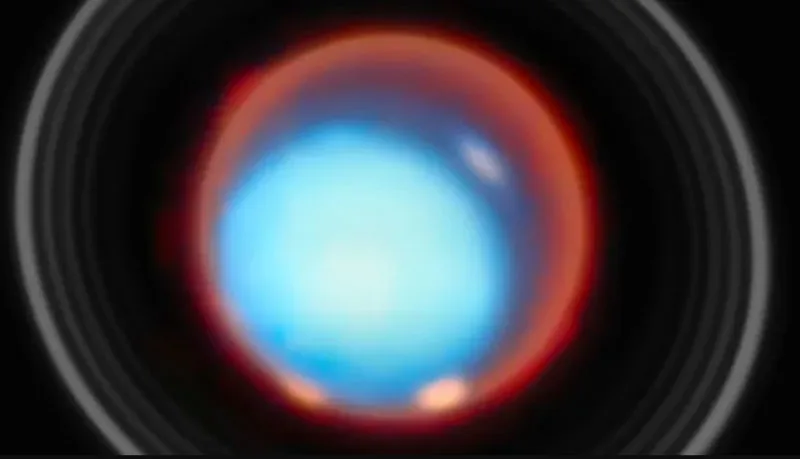
The James Webb Space Telescope has achieved a groundbreaking feat by generating the inaugural three-dimensional map of auroral activity on Uranus. This innovative observation sheds new light on the planet’s upper atmospheric dynamics and reveals auroras occurring beyond the polar regions, including near the equator.
An international team of astronomers conducted extensive observations of Uranus using the James Webb Telescope, tracking the planet for almost a full rotation period of approximately 17 hours. By doing so, they were able to collect unique spectral data from the upper layers of Uranus’s atmosphere, reaching altitudes of several thousand kilometers above its clouds.
This comprehensive dataset allowed researchers to create a detailed three-dimensional representation of the auroras on Uranus, which are typically associated with the planet’s polar regions on Earth and other planets. However, the new findings reveal that these luminous phenomena also extend toward the equatorial regions, offering fresh insights into the planet’s complex magnetospheric and atmospheric processes.
Uranus’s auroras are generated when charged particles interact with its magnetic field and atmospheric particles, producing light emissions. Mapping these events in three dimensions provides a clearer understanding of the structure and behavior of the planet’s magnetosphere and the interactions occurring in its upper atmosphere.
Prior to this study, Uranus had been observed mostly in two dimensions, limiting scientists’ ability to fully comprehend the spatial dynamics of its auroras. The James Webb Telescope’s capability to capture high-resolution spectral data over an extended period contributed critically to surpassing this limitation.
The new 3D auroral map has implications for broader planetary science as well, enhancing knowledge about gas giant atmospheres and magnetic field interactions. Understanding Uranus’s auroras in detail can also aid comparative studies with other planets in the solar system, including Jupiter and Saturn.
The research marks a significant achievement for the James Webb Space Telescope’s ongoing mission to expand humanity’s understanding of the solar system and beyond by providing unprecedented views of distant celestial objects and phenomena.
The James Webb Space Telescope has created the first three-dimensional map of auroras on Uranus, revealing activity even near its equator.