App Store Sees Surge in New Apps Amid Growth of No-Code Platforms in Early 2026
July 21, 2026
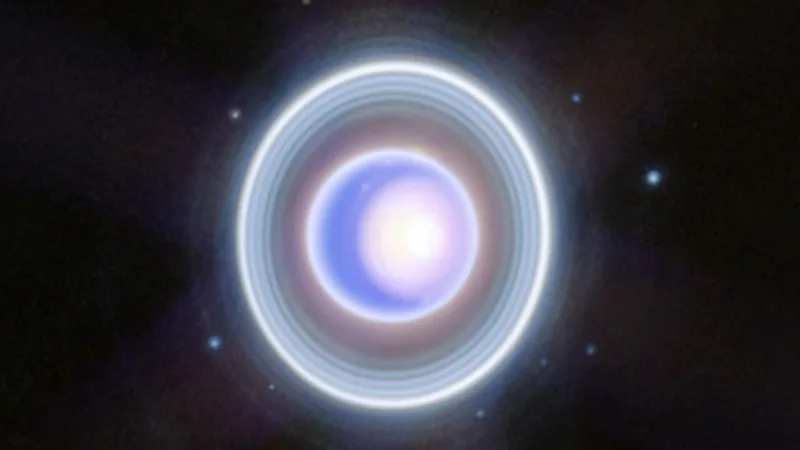
The James Webb Space Telescope, operated by NASA, has for the first time generated a complete spectral profile of two of Uranus’ outer rings, known as the mu (μ) and nu (ν) rings. This breakthrough observation has revealed unexpected details about the composition of these rings, providing new insights into their origins and the potential presence of additional, yet undiscovered, moons orbiting the planet.
By capturing the full reflection spectrum of Uranus’ μ and ν rings, the James Webb Telescope has differentiated these rings based on their material makeup. The data indicated that one of the rings is primarily composed of water ice, while the other contains organic materials rich in carbon. This clears up previous uncertainties about their nature and allows researchers to better understand the processes governing the formation and maintenance of such rings around a gas giant.
These rings are populated by particles that are believed to originate from small satellites orbiting Uranus. Interestingly, the study suggests that these moons have fundamentally different compositions, which aligns with the distinct characteristics of the rings they supply. This variation implies diverse geological histories or formation scenarios among Uranus’ moons.
Furthermore, the spectroscopic observations hint at the existence of additional moons beyond the 29 already confirmed around Uranus. These yet-to-be-discovered satellites could play significant roles in shaping the planet’s ring system and gravitational environment.
The findings represent an important step forward in the study of Uranus and its complex ring-moon system. With the powerful capabilities of the James Webb Telescope, astronomers are able to explore planetary features with unprecedented detail, opening new avenues for understanding the outer solar system’s dynamics and evolution.
Continued observations and analyses are expected to refine knowledge about these additional moons and their interactions with Uranus’ rings. Researchers anticipate that further data will help explain not only the compositional diversity of the rings but also the larger-scale processes influencing ring formation around ice giants.
NASA’s James Webb Telescope captured the complete spectral signature of Uranus’ outer rings, revealing distinct compositions and hinting at undiscovered moons.