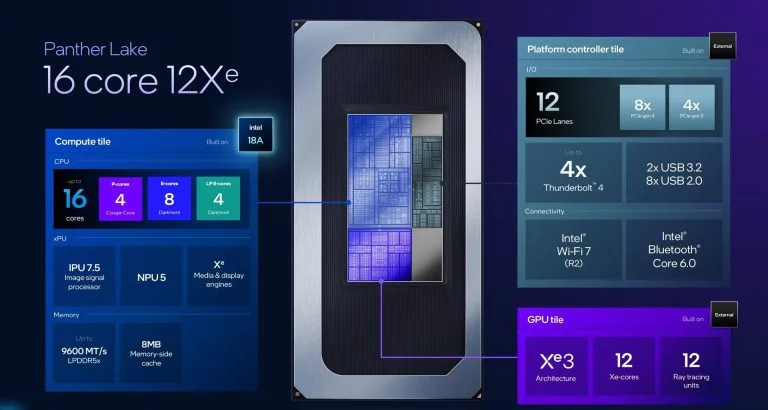
ASUS Unveils Updated Zenbook Duo UX8407A with Dual OLED Displays and Panther Lake Chip
June 23, 2026

Researchers at the Massachusetts Institute of Technology (MIT) have engineered a novel navigation chip designed for devices with strict energy constraints, such as small drones and augmented reality (AR) glasses. Known as Gleanmer, this specialized chip excels at generating three-dimensional maps of surrounding environments in real time.
The standout feature of the Gleanmer chip is its remarkably low power consumption. Operating at just 6 milliwatts—comparable to an ordinary LED—this chip offers continuous, reliable navigation capabilities without necessitating bulky power sources. This level of efficiency is particularly beneficial for miniaturized robotic systems and wearable technology, where power budgets are typically limited.
By enabling devices to accurately map their environment as they move, the chip facilitates obstacle avoidance and spatial awareness. Such functions are critical for small drones to navigate through complex or confined spaces and for AR glasses to overlay digital information anchored to real-world objects seamlessly.
The introduction of Gleanmer represents an important stride in embedded navigation technology, meeting the increasing demand for compact and energy-conscious components in consumer electronics and robotics. While full technical details and commercial availability have not been disclosed, the chip’s ability to maintain performance at extremely low power levels signals promising possibilities for future applications.
As the field of autonomous systems continues to expand, integrating navigation solutions like MIT’s chip into smaller platforms could enable new use cases and improve overall device endurance. This development aligns with broader trends aimed at enhancing on-device processing to reduce reliance on cloud connectivity, thereby improving speed, privacy, and reliability.
The advancement opens the door for various industries leveraging miniature robots and wearable AR gear to innovate their products with enhanced spatial intelligence powered by minimal energy consumption.
MIT engineers created the Gleanmer chip, enabling real-time 3D mapping for tiny robots and AR glasses at just 6 mW power consumption.