Advancements in CFET Technology Promise Faster, Smaller, and More Reliable Semiconductor Transistors
July 21, 2026
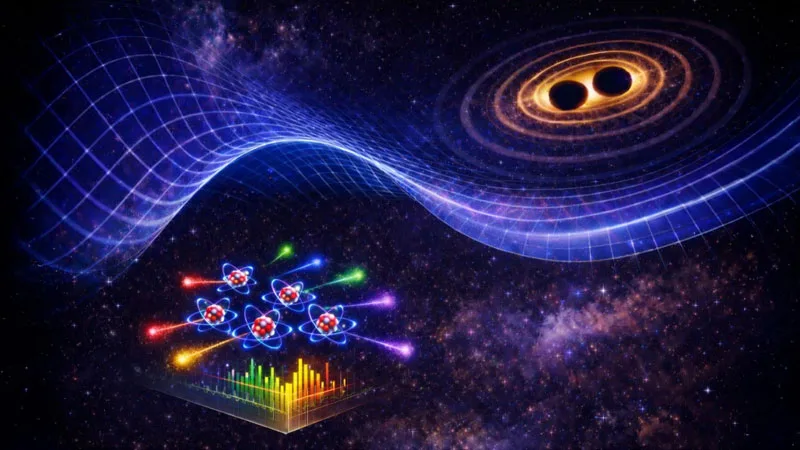
A team of scientists from Stockholm University, Nordita, and the University of Tübingen has introduced a fundamentally new approach for detecting gravitational waves. Unlike current methods that rely on large-scale interferometers stretching over kilometers, this technique is based on observing subtle shifts in the color of light emitted by atoms.
Gravitational waves are ripples in spacetime generated by massive cosmic events such as merging black holes or neutron stars. Detecting these waves has traditionally depended on hugely sensitive instruments like the Laser Interferometer Gravitational-Wave Observatory (LIGO), which measure minute changes in the length of laser beams caused by passing gravitational waves.
The new proposal suggests monitoring changes in the frequency, or color, of photons emitted by atoms. The passing of gravitational waves would influence the energy levels of these atoms, leading to detectable shifts in the emitted light’s characteristics. This concept leverages atomic-level processes and photonics to identify the presence of gravitational waves without relying on kilometer-scale setups.
If experimentally validated, this approach could enable the creation of smaller, more compact detectors. Such devices would potentially access a range of gravitational waves that remain undetectable by existing large interferometers, opening new avenues in astrophysical observations and fundamental physics.
The research highlights how advances in atomic physics and quantum optics can provide innovative solutions to longstanding challenges in astrophysics and cosmology. By reducing the physical footprint required for gravitational wave measurements, these new detectors might also facilitate broader use in various scientific and possibly industrial contexts.
While the theoretical foundation shows promise, further experimental work will be necessary to confirm the feasibility and sensitivity of this detection method. If successful, this paradigm shift could supplement and diversify the toolkit available for exploring the cosmos through gravitational wave astronomy.
Scientists suggest detecting gravitational waves by monitoring color changes in photons emitted by atoms, enabling more compact detectors.