
OneXPlayer Launches Portable Gaming Device with Intel Arc G3 Extreme Graphics Starting at $1399
June 23, 2026
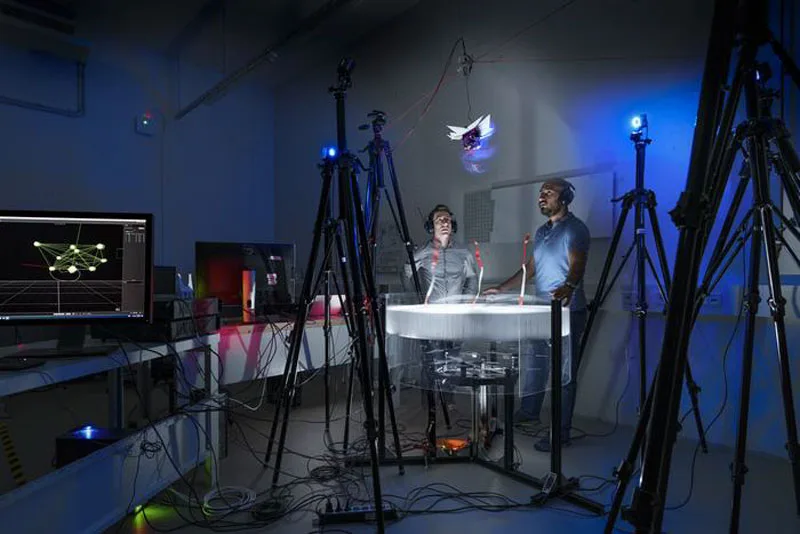
A team of scientists at the Max Planck Institute for Intelligent Systems in Tübingen, in collaboration with the University of Stuttgart, has introduced a groundbreaking flying robot named Floaty. Unlike conventional drones and aircraft that rely on propellers or engines to generate lift, Floaty achieves sustained flight by utilizing natural ascending air currents.
Floaty’s design draws inspiration from avian flight patterns that exploit rising air streams or thermals to soar effortlessly. By harnessing these upward air movements, the robot can maintain altitude with significantly lower energy consumption than traditional rotor-driven drones or powered airplanes. This novel approach opens the door to new possibilities in aerial robotics where endurance and energy efficiency are critical.
The floating robot’s reliance on natural airflow rather than mechanical thrust allows it to glide gracefully as birds do, making the technology potentially applicable in areas where long-duration flight and minimal power requirements are paramount.
In addition to serving as a proof of concept for sustainable flight, the principles behind Floaty’s operation may be adapted to other aerial vehicles. The research team suggests that this method of flight control could inform the development of future rocket navigation systems or meteorological probes that require stable, energy-conscious flight through the atmosphere.
While specific technical parameters, deployment scenarios, and commercial availability remain forthcoming, the Floaty project represents a promising advancement in aerial robotics and energy-efficient flight technologies.
A new flying robot developed by German researchers uses ascending air currents to stay aloft, drastically reducing energy consumption compared to drones and airplanes.