App Store Sees Surge in New Apps Amid Growth of No-Code Platforms in Early 2026
July 21, 2026
Scientists in the United States have advanced the theoretical understanding of a longstanding materials science puzzle known as the “ideal glass” paradox, originally proposed in the late 1940s. This breakthrough sheds new light on the concept of an amorphous solid with exceptional stability, combining structural disorder with unexpectedly low entropy.
In 1948, physicist Walter Kauzmann put forward a hypothesis about a special amorphous material that would challenge existing views on glass and solid-state structures. Kauzmann suggested the existence of a glassy state with nearly zero entropy—meaning an incredibly ordered thermodynamic state—yet retaining a disordered, non-crystalline arrangement of particles. Such a material, often referred to as the “ideal glass,” would possess extraordinary stability and order without crystallization, potentially exhibiting unique mechanical and physical properties.
Despite decades of research, this ideal material remained elusive, raising questions about the fundamental physics governing glass formation and stability. The central paradox lies in reconciling the seemingly contradictory characteristics: minimal entropy traditionally corresponds to crystalline solids, while glasses exhibit high entropy due to their disordered atomic structure. Kauzmann’s idea challenged researchers to conceive how a material could behave thermodynamically like a crystal yet remain amorphous.
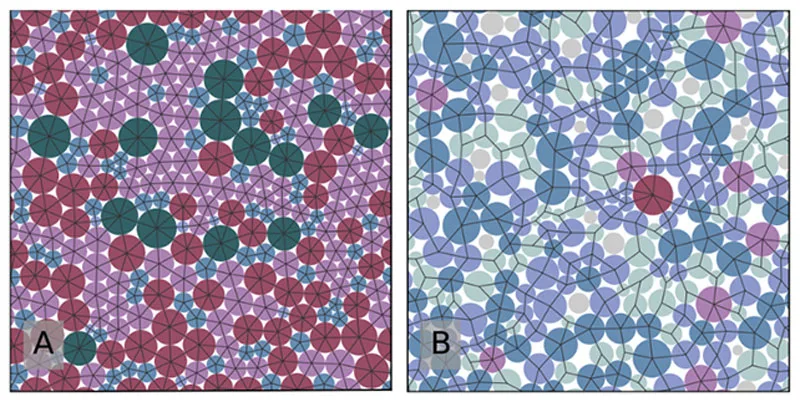
The recent theoretical work from American researchers aims to resolve this paradox by exploring the microscopic mechanisms that might allow for stable amorphous states with near-zero entropy. By analyzing particle interactions and configurations at a detailed level, the scientists propose scenarios that could lead to a form of “ideal glass” possessing diamond-like mechanical stability combined with the disordered nature typical of glass.
Furthermore, the research touches on materials that blend properties of different states, illustrating a conceptual crossover between diamond-like rigidity and metallic characteristics with glass-like atomic arrangements. This has implications for developing new materials that merge the best traits of both classes, potentially leading to applications in advanced manufacturing, electronics, and nanotechnology where stability and unusual structural properties are prized.
While the findings remain theoretical and experimental validation has yet to be achieved, this progress marks an important step in materials science. Understanding and eventually synthesizing an ideal glass could revolutionize how materials are designed, moving beyond the traditional crystalline versus amorphous dichotomy.
The discovery underscores the ongoing importance of theoretical frameworks in unveiling the complex behaviors of matter and opens promising avenues for future research into previously unattainable material properties.
Researchers outline a theoretical model that could explain and realize the ‘ideal glass’ combining diamond-like stability with glass-like disorder.