Advancements in CFET Technology Promise Faster, Smaller, and More Reliable Semiconductor Transistors
July 21, 2026
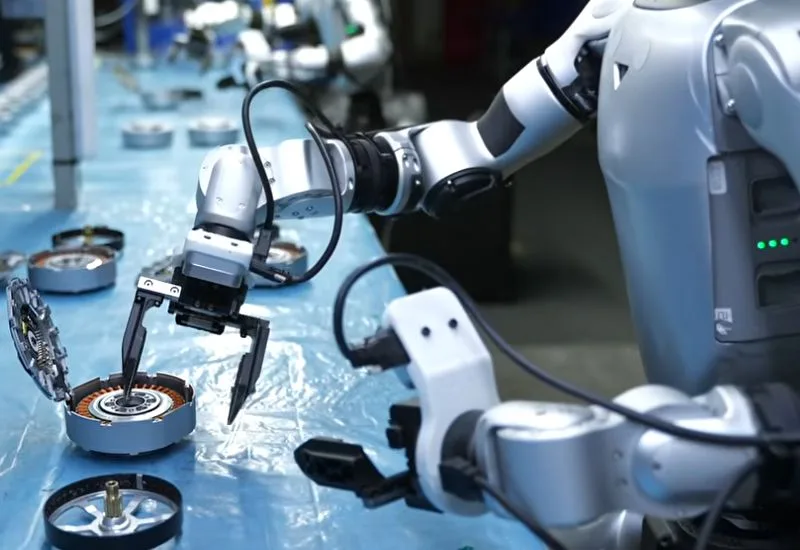
Unitree, a Chinese robotics company, has unveiled a humanoid robot designed to assemble components for other robots within its manufacturing facility. This development reflects a notable change in the industrial robotics sector, which traditionally relied on highly specialized, stationary machines.
The industrial robotics landscape has historically emphasized robots built for narrowly defined tasks, mostly confined to fixed locations on the manufacturing floor. However, recent trends suggest a pivot toward robots that mimic human abilities more closely, bringing greater flexibility and adaptability to automation.
Unitree’s humanoid robot, known as the G1, operates under a newly introduced control framework termed UnifoLM-X1-0. In a live demonstration, the robot was shown performing the intricate task of assembling parts destined for other units of the same robot model. This showcases the potential for humanoid robots to take on complex manufacturing roles that were once exclusively human domains.
The use of humanoid robots in assembly lines could signal a significant transformation in how factories integrate robotic assistance. By leveraging advanced control models and humanlike dexterity, these robots could handle a range of duties beyond repetitive tasks, including those requiring precision or adaptability.
While many current industrial robots excel in speed and repetition, their lack of versatility can limit applications. Unitree’s approach, featuring a humanoid form factor and advanced AI control, aims to overcome these constraints. The G1’s ability to manipulate parts and tools in an assembly environment suggests a move toward more generalized robotic labor.
Details regarding the technical specifications of the G1 robot and its control system UnifoLM-X1-0, as well as plans for broader deployment, have not been extensively disclosed. Nonetheless, the demonstration highlights the evolving role of robots within manufacturing settings, where collaboration between humans and robots is becoming increasingly sophisticated.
Unitree’s initiative aligns with a wider industry trend prioritizing robots capable of operating in less structured environments and performing duties traditionally reserved for human workers. As companies seek to enhance productivity while addressing labor shortages, humanoid robots may provide a viable solution for future manufacturing operations.
This move by Unitree adds to the global conversation about the next generation of robotics, where form and function converge to create machines that can both navigate and interact within human-centric workspaces effectively.
Chinese robotics firm Unitree showcases a humanoid robot assembling parts for other robots, marking a shift in industrial automation.