
Honor Launches X7e Smartphone in Russia Featuring 7200mAh Battery and AI Shortcut Button
July 21, 2026
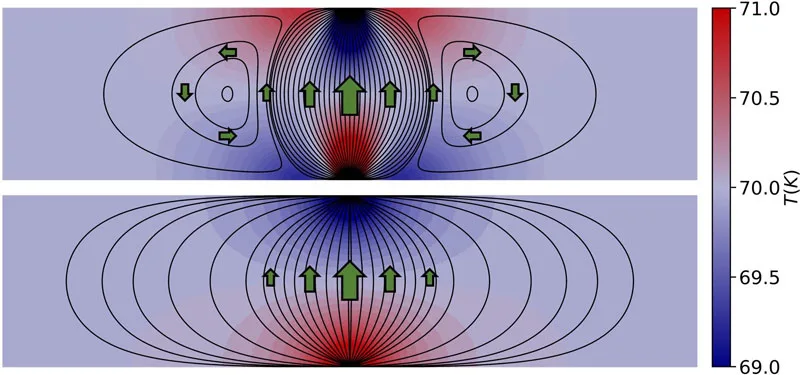
Scientists at the École Polytechnique Fédérale de Lausanne (EPFL) have made a significant theoretical breakthrough by demonstrating that heat can exhibit fluid-like behavior in highly ordered, ultra-pure crystals. This new understanding challenges the conventional notion that heat merely diffuses from hot to cold regions and suggests potential advances in the way heat is managed in technology, including the cooling of computer chips.
Typically, heat transfer is understood as a simple gradient-driven process where thermal energy moves passively from warmer areas to cooler ones. However, the EPFL research reveals that under specific conditions—particularly in crystals with a very high degree of purity and structural order—heat transport can take on characteristics more akin to a flowing fluid. This means that instead of moving uniformly and dissipating, heat may form directed currents, including swirling vortices and even reverse circulation patterns.
This behavior is akin to the dynamic movement of liquids, contrasting sharply with the traditional view of heat conduction as a random scattering of vibrational energy. This analogy can be conceptualized by picturing heat as a fluid wrapping around an object, creating complex flow patterns rather than simply radiating outwards.
The findings are rooted in principles of quantum mechanics, where the collective behavior of phonons—the quanta that carry heat in insulators and semiconductors—can exhibit wave-like properties leading to such unusual heat flow phenomena. These effects become prominent when the crystal lattice is nearly defect-free, allowing phonons to travel coherently over longer distances.
The ability of heat to move as a fluid could lead to entirely new strategies for thermal management in electronic devices. One of the most immediate applications is in microprocessor cooling, where efficient heat removal is paramount for maintaining performance and preventing damage due to overheating.
Current cooling solutions largely rely on conventional conduction and convection principles. The possibility of controlling heat flow in a more directed and dynamic fashion could enable the design of materials and components that guide heat away from hotspots more effectively, potentially surpassing the capabilities of existing technologies.
Beyond chip cooling, this discovery may have broader implications for thermal engineering in various fields, offering new avenues to manipulate heat at the nanoscale. It also enriches the theoretical framework of how energy transport operates in quantum materials, which remains an active frontier in condensed matter physics.
While the research remains theoretical at this stage, it lays important groundwork for future experimental investigations aimed at harnessing fluid-like thermal transport in real-world materials. Such progress could revolutionize thermal control methods in electronics, photonics, and possibly even energy systems.
Researchers at EPFL found that in ultra-pure crystals, heat can flow similarly to liquids, suggesting new approaches to thermal management in electronics.