NASA and SpaceX to Equip Artemis III Orion with Starlink Laser Terminals
July 21, 2026
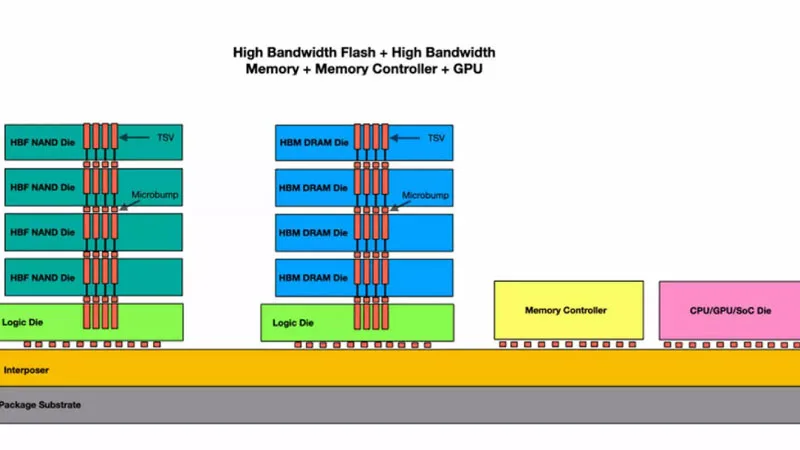
SK hynix has unveiled a hybrid memory architecture designed to accelerate the performance of artificial intelligence (AI) models by integrating two distinct types of memory: high-bandwidth memory (HBM) and a flash-based memory concept known as HBF. This approach seeks to address the limitations of current AI hardware by increasing the memory capacity adjacent to processors, thereby enabling faster decision-making.
The idea of enhancing AI model speed by positioning larger memory pools closer to computing units has gained traction across the technology sector in recent years. Rather than relying solely on DRAM-based HBM, which offers high speed but relatively lower density, SK hynix’s hybrid system introduces NAND flash-derived memory, termed HBF, which provides greater storage density in the same physical footprint.
This combination leverages the speed advantages of HBM with the denser, cost-effective nature of flash memory, potentially expanding the available space for model tokens—a critical factor in AI computations. By enabling larger token capacity near the processor, AI models can process more data simultaneously, speeding up inference and overall throughput.
The concept of replacing or supplementing HBM with flash-based memory for AI acceleration is not new. About a year ago, SanDisk announced exploring similar ideas to substitute DRAM with flash for enhanced memory density in AI hardware. SK hynix’s recent publication reiterates this hybrid memory architecture as a viable pathway to overcoming current memory bottlenecks in high-performance AI applications.
Integrating NAND flash alongside HBM into a single hybrid memory framework presents engineering challenges, especially regarding balancing latency and bandwidth requirements characteristic of AI workloads. However, the potential benefit lies in significantly increasing localized memory capacity without a proportional increase in power consumption or physical size, factors critical to the scalability of AI processors.
While detailed technical specifications, performance metrics, and commercial availability timelines of SK hynix’s hybrid HBM-HBF memory were not disclosed, the initiative highlights ongoing industry efforts to innovate memory architectures for future AI systems. This approach aligns with broader trends of combining complementary memory technologies to meet escalating demands for data-intensive and latency-sensitive AI applications.
As artificial intelligence continues to evolve, hardware advancements such as hybrid memory structures may play a pivotal role in enabling more complex models with faster, more efficient processing. SK hynix’s work contributes to this evolving landscape by offering a practical solution to one of the fundamental challenges: the trade-off between memory speed and capacity.
SK hynix introduces a hybrid memory approach combining HBM and flash-based HBF to enhance AI model processing speeds by increasing token storage capacity.