
Nvidia Expands Beyond GPUs with Significant Shipments of Arm-Based CPUs for Servers
July 21, 2026
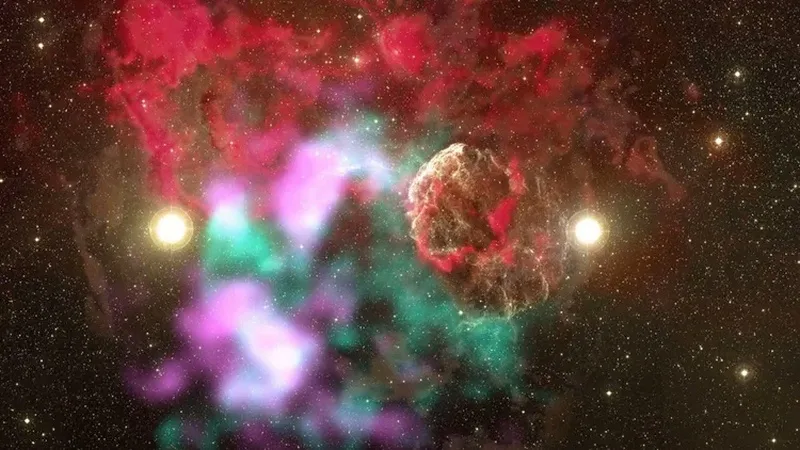
Astronomers have identified what appears to be the first known instance of a binary star system in which both stars have undergone supernova explosions. This discovery marks a significant milestone in celestial observations and provides new insights into the life cycles of massive stars within multi-star systems.
Binary star systems are common in the universe, comprising more than half of all known star systems, particularly among those hosting massive stars. These systems involve two stars gravitationally bound to each other and often influence one another’s evolution through their close proximity. Yet, until now, researchers had not documented a pair of stars within such a system both reaching the terminal stage of supernova explosions.
Supernovae are the astrophysical phenomena in which a star exhausts its nuclear fuel and undergoes a catastrophic explosion, resulting in an incredibly luminous event and leaving behind dense remnants such as neutron stars or black holes. Typically, astronomers study supernovae as isolated events or within one star of a binary pair, but the detection of both stars in a binary system exploding as supernovae is unprecedented.
The newly reported system draws parallels to fictional double-star systems such as the one depicted in the Star Wars universe’s planetary system Tatooine, where two suns orbit each other. While the discovery does not imply habitable planets or galactic narrative elements, it underscores the complexity and variety of stellar arrangements existing in our cosmos.
This finding opens new avenues for understanding the dynamics of massive star interactions and the ultimate fate of such systems. It also presents opportunities to study how the aftermaths of these explosions—such as shockwaves, radiation, and compact objects—affect their surroundings when two supernovae occur within the same gravitationally connected system.
Further research and observation will be required to understand the specifics of both explosions and the system’s evolution prior to this rare dual supernova occurrence. This event enriches the astrophysical community’s knowledge of stellar evolution pathways in binary systems and contributes to refining models of massive star life cycles.
A groundbreaking discovery reveals a binary star system in which both stars have ended their life cycles in supernova explosions.