Oracle’s Debt Challenges Threaten AI Data Center Project for OpenAI
July 21, 2026
A collaborative effort between IBM and Japan’s RIKEN research institute has led to a significant breakthrough in computing technology by enabling a seamless operational cycle combining a supercomputer with a quantum processor. This achievement marks the first instance in which these two systems continuously exchange intermediate calculation data to work towards a unified computational goal.
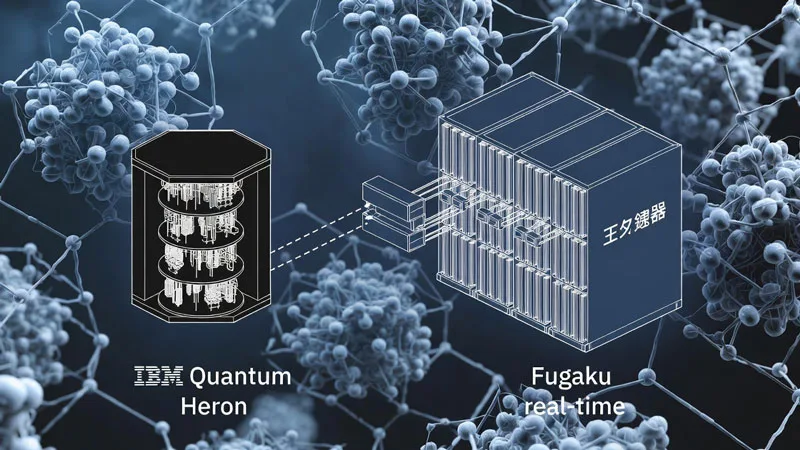
The joint team focused on advancing the concept of Quantum-Centric Supercomputing (QCSC), which aims to harness the complementary strengths of traditional supercomputers alongside cutting-edge quantum devices. Traditionally, these two computing paradigms have operated separately due to the challenges in integrating their vastly different architectures and data structures. The new development demonstrates a closed-loop system where a quantum processor and a supercomputer are positioned adjacent to each other and actively share intermediate results in real-time.
This integration enables continuous data flow, allowing each system to benefit from the other’s computational advantages. The supercomputer handles large-scale data and classical processing tasks, while the quantum processor tackles complex problems suited to its quantum algorithms. The seamless data exchange between the two fosters a collaborative environment where iterative computation cycles refine and enhance the overall output without manual intervention.
By designing this tightly coupled interaction, IBM and RIKEN have paved the way for hybrid computing systems that can address increasingly sophisticated scientific and engineering problems. This breakthrough supports the vision of QCSC as a transformative approach to high-performance computing, blending quantum and classical methodologies into a single workflow.
Although specific technical details and performance metrics were not disclosed, this milestone signals a promising future for applications that demand vast computational power combined with quantum speedups. Research institutions and industries alike could benefit from such hybrid architectures, as they might unlock new capabilities in fields including materials science, cryptography, optimization, and artificial intelligence.
The collaboration between IBM and RIKEN continues to underscore global efforts to push the boundaries of computing technology by integrating quantum and classical systems more effectively. This achievement serves as a foundational step toward more widespread deployment of Quantum-Centric Supercomputing platforms capable of accelerating breakthrough research and development initiatives.
IBM and Japan’s RIKEN institute have created the first continuous data exchange loop between a supercomputer and a quantum processor.