
Popular PC Components in Russia Highlight Nvidia RTX 50 Series and 1TB NVMe SSDs
July 21, 2026
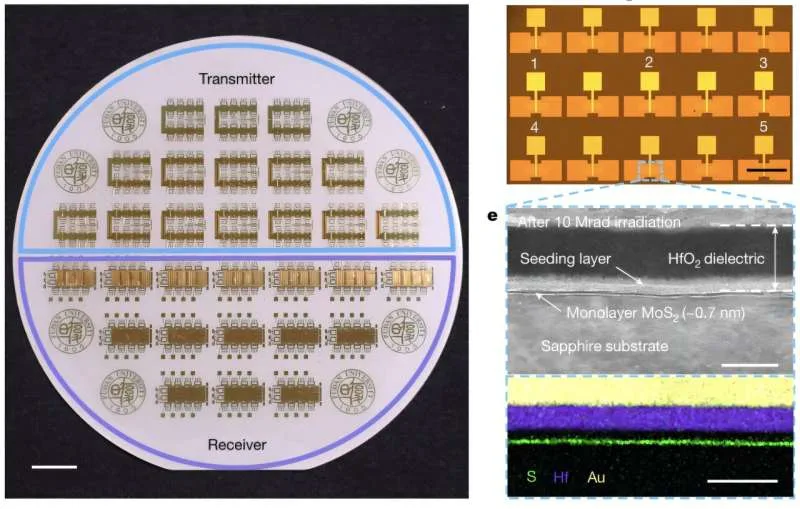
Researchers at Fudan University in China have introduced an innovative method to enhance the radiation resilience of electronics designed for space applications. This breakthrough could address the longstanding issue of semiconductor damage caused by cosmic particles.
One of the primary challenges faced by conventional electronic chips in space environments is their vulnerability to radiation from high-energy particles. These particles often cause disruptions and physical damage within the semiconductor material, leading to malfunction or total failure of the electronic components.
The team from Fudan University proposed a new approach by engineering the functional layer of transistors to be only an atom thick. This atomically thin design allows charged particles, such as cosmic rays, to pass through the transistor layer without getting trapped or causing detrimental effects.
In essence, the transistor’s active layer becomes ‘invisible’ to radiation, minimizing the interaction between the high-energy particles and the electronic material. This results in a significant reduction in radiation-induced damage, potentially extending the lifespan and reliability of electronics used in harsh outer space conditions.
The approach contrasts with traditional methods that rely on radiation shielding or modifying semiconductor materials to resist damage. By fundamentally altering the transistor structure to an atomically thin dimension, the researchers introduced a novel pathway for achieving radiation hardness at the material design level.
This strategy not only offers promising applications for space-grade electronics but could also impact other fields where radiation resistance is crucial, such as nuclear energy and high-radiation industrial environments.
While the research marks an important step forward, further development and testing will be necessary to fully integrate this technology into commercial space systems. Details on manufacturing scalability, integration with existing circuitry, and performance under varied radiation scenarios remain areas for future exploration.
Fudan University scientists create radiation-resistant electronics for space by using atom-thin transistor layers that allow particles to pass without damage.