
Thermalright Introduces Royal Pretor 130 Vision Cooler with Integrated 3.95-Inch Color Display
July 21, 2026
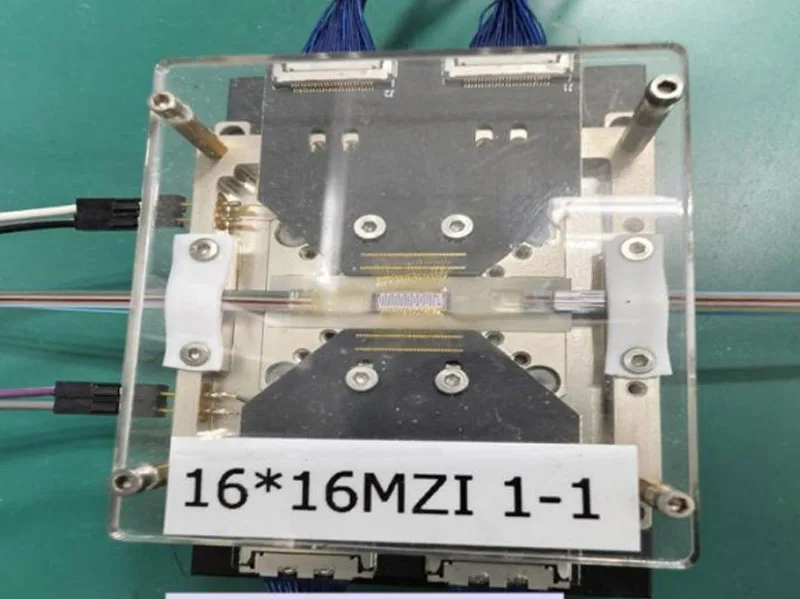
Researchers at Xidian University in China have introduced a groundbreaking photonic neural computing system that performs reinforcement learning entirely through light, without converting signals into electrical pulses. This innovation marks a significant leap in silicon photonics, opening new possibilities for faster and more efficient machine learning processes.
Traditional photonic spiking neural networks have been limited to linear computations, primarily because key operations relied on translating optical signals into electrical currents. This conversion step has been a bottleneck, restricting photonic systems from handling the nonlinear transformations necessary for advanced neural network functions such as reinforcement learning.
The team at Xidian University has developed a novel approach that eliminates the need for optical-to-electrical signal conversion during critical computation phases. Their new photonic neural system executes reinforcement learning purely by manipulating photons, which operate at the speed of light, leading to dramatic improvements in processing speed and energy efficiency.
This all-optical methodology enables nonlinear computations directly in the photonic domain, a milestone that previous photonic neural networks could not achieve. The breakthrough demonstrates the viability of applying photonic technology to complex AI tasks that require dynamic learning and decision-making.
The implications of this research are broad, potentially benefiting fields where rapid and efficient neural processing is vital. Industries such as robotics, autonomous systems, and high-performance AI acceleration stand to gain from the capabilities unlocked by this silicon photonics advancement.
While specific details about the underlying architecture and performance metrics have not been disclosed, the development represents a crucial step toward integrating photonic computing with AI models that demand sophisticated learning algorithms. By leveraging light-based computation, future intelligent systems may achieve unprecedented speeds and operational efficiencies.
This progress aligns with the growing global interest in alternative computing paradigms designed to overcome the limitations of traditional electronic processors. Silicon photonics, with its ability to process information at light speed and low power consumption, is increasingly recognized as a promising foundation for next-generation AI hardware.
As this technology matures, it could transform how AI models are implemented in both research and commercial applications, potentially enabling robots and autonomous agents to “think” and learn with greater rapidity and adaptability than ever before.
Scientists at Xidian University develop a photonic neural computing system enabling reinforcement learning solely with light signals.