Oracle’s Debt Challenges Threaten AI Data Center Project for OpenAI
July 21, 2026
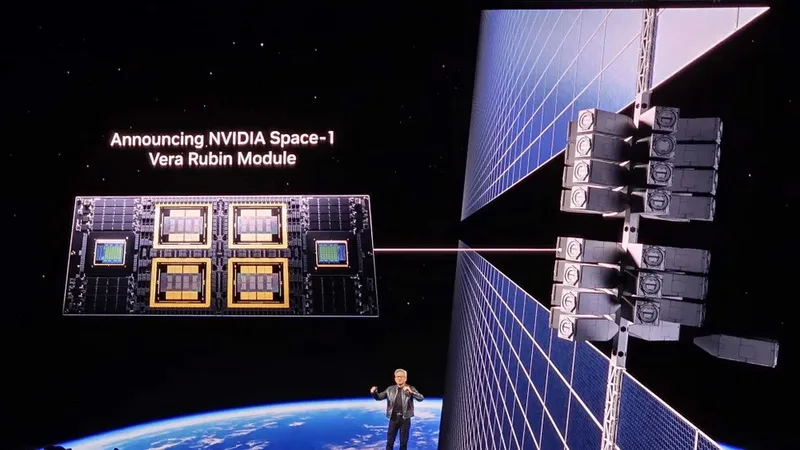
At the 2026 GPU Technology Conference (GTC), Nvidia introduced its new Space-1 Vera Rubin Module aimed at revolutionizing artificial intelligence computing beyond Earth. This innovative module targets orbital AI servers, promising a significant jump in computational capabilities designed specifically for space applications.
The development of Nvidia’s Space-1 Vera Rubin Module reflects the growing emphasis on deploying powerful computing resources in space environments. According to Nvidia’s CEO, Jensen Huang, the module delivers a remarkable boost in performance, offering up to 25 times the AI processing power when compared to existing servers equipped with Nvidia’s H100 GPU accelerators.
This increase in computational strength is particularly notable given the growing demand for on-orbit data processing. With satellites and space stations generating vast amounts of data, onboard AI processing can significantly reduce reliance on ground-based systems and enable faster decision-making in real time.
The new module aligns with Nvidia’s broader vision of integrating advanced AI workloads into domains beyond traditional data centers. Space-based AI servers could facilitate complex tasks such as remote sensing, autonomous spacecraft navigation, and environmental monitoring, which all benefit from high-performance computing close to the data source.
While technical details about the Space-1 Vera Rubin Module’s architecture, power consumption, or other specifications were not disclosed during the announcement, the substantial performance uplift suggests Nvidia has made key advancements in adapting its GPU technology for the challenges of space deployment, such as radiation resilience and thermal management.
The announcement marks a significant milestone in the evolution of space computing technology, highlighting Nvidia’s strategic commitment to pioneering AI infrastructure that operates in orbit. The emergence of reliable, high-performance AI servers in space could open new possibilities for industries ranging from telecommunications and earth observation to scientific research and space exploration.
Nvidia introduces the Space-1 Vera Rubin Module, a powerful AI computing unit designed for orbital servers with up to 25 times greater performance than H100-based systems.