
Thermalright Introduces Royal Pretor 130 Vision Cooler with Integrated 3.95-Inch Color Display
July 21, 2026
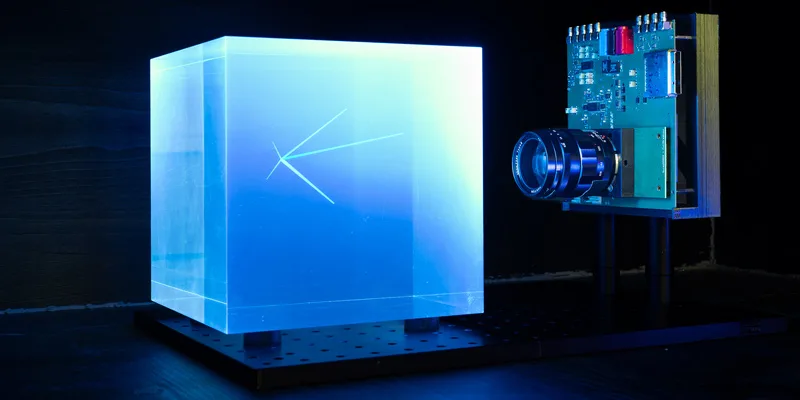
An international consortium of researchers, led by physicists from Switzerland, has introduced an innovative approach to detecting elementary particles such as neutrinos and dark matter. This new development centers on a light-field camera combined with an advanced photon sensor, marking a departure from the bulky traditional detectors commonly used in particle physics experiments.
Conventional particle detectors often consist of thousands of separate segments designed to capture and analyze signals from elusive particles. These setups, while effective, are usually large, complex, and expensive, posing challenges for scaling and widespread deployment. The newly proposed detector simplifies this process by employing a single light-field camera integrated with a highly sensitive photon detector capable of registering the faintest traces of particle interactions.
The novel detector leverages the capability of light-field cameras to capture detailed spatial and angular information of incoming photons. Combined with the photon sensor’s heightened sensitivity, the system can pinpoint particle events with significant precision. This approach reduces the need for multiple detector segments by consolidating the detection process into one compact unit.
This streamlined design not only reduces complexity but also offers potential cost benefits, making particle detection experiments more accessible to a broader range of research teams. The ability to simplify hardware without compromising detection capabilities could accelerate experimental timelines and enhance the study of phenomena such as neutrino interactions and dark matter detection.
Neutrinos and dark matter particles are notoriously difficult to observe due to their minimal interaction with ordinary matter. Traditional detection methods require elaborate setups to track the rare occurrences when these particles interact with detector materials. The light-field approach captures subtle light signals resulting from these interactions, opening new pathways for observing these elusive particles.
The research team highlights that this innovative detector design could revolutionize experimental frameworks in particle physics. By significantly decreasing size and cost, this technology may lead to more extensive deployment of detection arrays, improving overall sensitivity and data collection capacity across multiple research facilities worldwide.
While detailed specifications and deployment plans remain forthcoming, the introduction of a light-field camera paired with a sensitive photon sensor represents a promising leap in particle detection technology. Future developments and experimental validation will determine the full implications of this approach for advancing understanding in fundamental physics.
A new light-field camera paired with a sensitive photon sensor offers a simpler, cost-effective approach to detecting elusive neutrinos and dark matter.