Oracle’s Debt Challenges Threaten AI Data Center Project for OpenAI
July 21, 2026
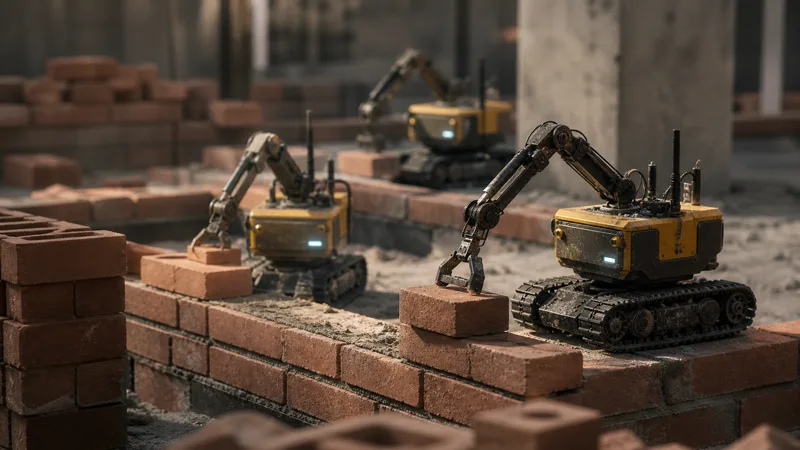
As space agencies contemplate the initial phases of planetary colonization, robots are expected to play a crucial role. These machines will vary greatly in size, spanning from large industrial units to extremely small devices. However, the limited computational power inherent to smaller robotic platforms presents a significant challenge for implementing advanced artificial intelligence systems.
To address this issue, researchers have turned to natural models of collective behavior observed in earthbound insect species, particularly ants. These insects exhibit what appears to be a form of collective intelligence, achieved through relatively simple individual behaviors rather than sophisticated cognitive processing. Such swarm dynamics allow complex tasks like constructing and deconstructing nests or paths to emerge from the actions of many simple agents working in coordination.
Recent developments in robotics have demonstrated that robotic ants can successfully perform construction and demolition tasks without relying on advanced AI algorithms. Instead, these robots utilize straightforward behavioral rules that mimic those found in real ant colonies. By interacting with each other and their environment under these simple protocols, the robots collectively organize to build and dismantle structures effectively.
This approach not only reduces the computational demands placed on individual robots but also increases system robustness. Without the need for powerful onboard processors or complicated decision-making frameworks, swarms of minimalist robots can be deployed in environments with stringent size and power constraints, such as extraterrestrial surfaces.
Exploring and refining these swarm robotics strategies is critical as humanity prepares for off-world habitation. Understanding how to replicate the efficiency of insect collective intelligence in robotic systems offers a promising path forward. It suggests that leveraging distributed cooperation via basic behavioral models can substitute for complex centralized AI in many practical applications involving robot teams.
Future research will likely continue to investigate and expand these concepts, optimizing the protocols and hardware needed for multi-agent systems to perform more diverse and challenging operations. The implications extend beyond space missions, potentially transforming automation and robotics in various terrestrial industries.
Robotic ants replicate collective insect behavior to build and tear down structures without relying on complex artificial intelligence.