App Store Sees Surge in New Apps Amid Growth of No-Code Platforms in Early 2026
July 21, 2026
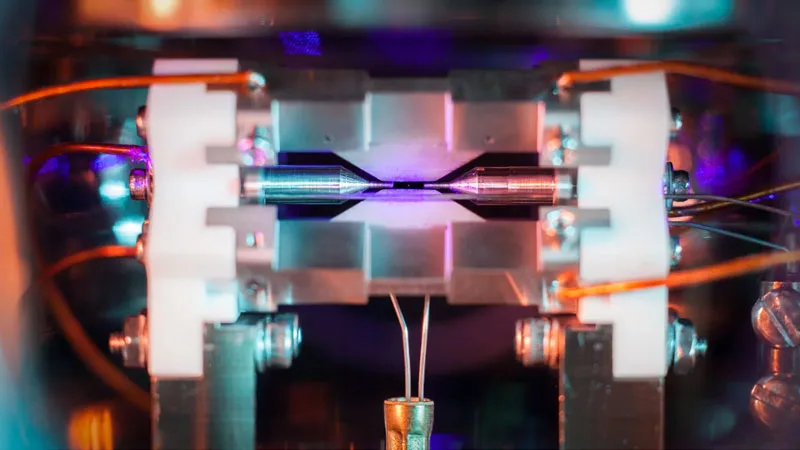
Researchers at Oxford University have successfully demonstrated quantum interactions of the fourth order for the first time, marking a notable advancement in the study of the fundamental properties of the universe. This pioneering work deepens insight into quantum mechanics, the field that describes the behavior of particles at microscopic scales.
Quantum mechanics imposes fundamental limits on the simultaneous measurement of certain pairs of physical properties, such as the exact position and momentum of an electron. This limitation, known as the Heisenberg uncertainty principle, allows precise knowledge of one characteristic only at the expense of certainty in its complementary property.
Traditionally, this phenomenon has been visualized as a transformation of the uncertainty region in phase space from a circle into an ellipse—a process known as squeezing—whereby uncertainty is reduced in one parameter while increased in the other. The Oxford team has pushed beyond this conventional squeezing, demonstrating more intricate patterns of uncertainty reduction that form petal- and spike-like shapes instead of smooth ellipses.
These higher-order quantum interactions represent subtler correlations between particle properties that standard quantum theory alone cannot fully characterize. By harnessing fourth-order interactions, the researchers have opened up new avenues to achieve more refined control over quantum states. This holds potential implications not only for fundamental physics but also for fields relying on quantum information and precision measurements.
The discovery enhances the theoretical framework for understanding complex quantum states and could lead to improved experimental techniques, offering deeper exploration of the underlying principles governing the universe’s behavior at the smallest scales.
Oxford scientists have realized fourth-order quantum interactions, advancing understanding of the universe’s fundamental physics.