
Oracle’s Debt Challenges Threaten AI Data Center Project for OpenAI
July 21, 2026
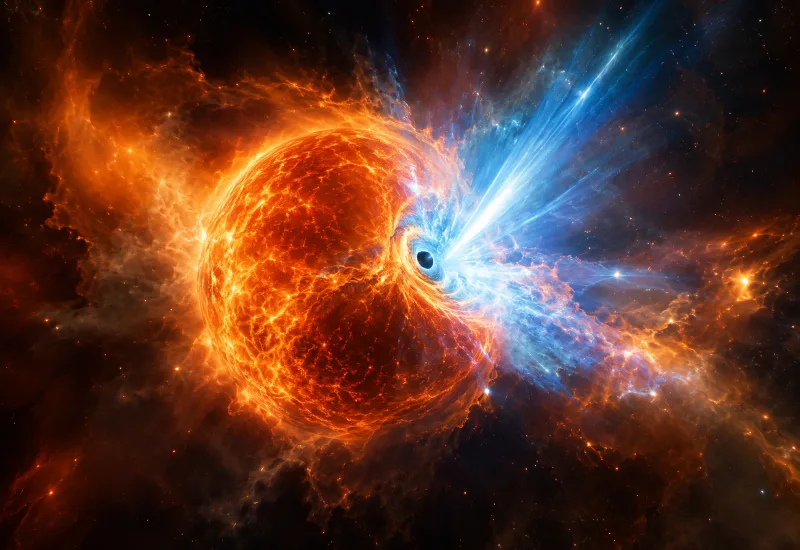
Since 2018, astronomers have been intrigued by the appearance of intense blue flashes scattered across the universe, phenomena that have puzzled experts due to their unusual properties and origins. A collaborative team from the Center for Astrophysics at Harvard University has now put forward a hypothesis that may shed light on the processes producing these enigmatic events.
The research team focuses on what are known as luminous fast blue optical transients (LFBOTs). These brief but extremely bright bursts have defied explanation for several years, standing out for their distinctive blue coloration and rapid evolution. According to the scientists’ recent analysis, these flashes could result from rare and violent interactions between compact objects such as black holes or neutron stars and a specific type of star known as a Wolf-Rayet star.
Wolf-Rayet stars are characterized by their exposed, hot helium cores, having lost their outer layers of hydrogen. They are massive stars in an advanced evolutionary stage, frequently associated with powerful stellar winds and significant mass loss. The hypothesis suggests that when a black hole or neutron star collides with such a star, the resultant interactions produce the conditions necessary for the luminous blue transients observed.
This theory provides a plausible astrophysical mechanism behind the generation of these flashes, which emit strong radiation over short timescales and present a challenge to prior models of stellar explosions and transients. The merger or disruption of the Wolf-Rayet star by the compact object could explain both the luminosity and the spectral characteristics recorded during these cosmic events.
Understanding these flashes is important for astrophysics as it expands knowledge about extreme phenomena in the universe, including the behavior of matter under intense gravitational forces and the final stages of massive stellar life cycles. The findings contribute to the growing catalog of transient space events detectable with modern telescopes and highlight the complex dynamics that can occur in binary star systems involving compact remnants.
While this explanation marks a significant step forward, the research community continues to collect observational data and refine theoretical models to fully elucidate these mysterious flashes. Future studies will likely explore the frequency of such collisions and their impact on galactic environments to improve comprehension of these dramatic cosmic occurrences.
Harvard scientists propose a new explanation for powerful blue flashes in space observed since 2018, linking them to rare cosmic collisions.