
Popular PC Components in Russia Highlight Nvidia RTX 50 Series and 1TB NVMe SSDs
July 21, 2026
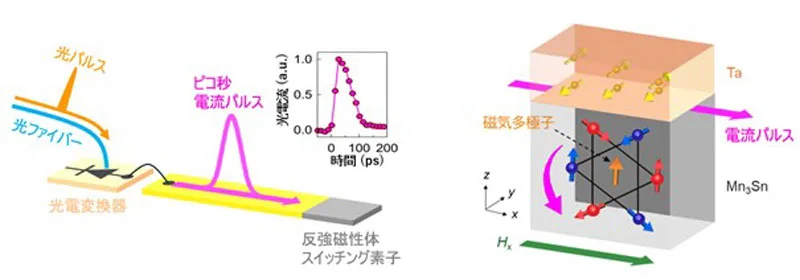
Researchers at The University of Tokyo, in collaboration with scientists from the RIKEN Center for Emergent Matter Science (CEMS), have introduced a novel type of memory device that leverages quantum mechanical effects to achieve significant advances in data storage performance and energy efficiency. This newly developed memory technology utilizes the transfer of electron spin-orbit momentum rather than the traditional electron charge flow, marking a departure from conventional memory architectures.
The innovation centers on a magnetic memory element that operates fundamentally differently from existing dynamic random-access memory (DRAM) technology. Instead of depending on electrical currents to switch states, this device exploits quantum spin-orbit coupling—the intrinsic relationship between an electron’s spin and its orbit around the atomic nucleus—to manipulate memory states. This mechanism allows the memory to switch states at speeds up to 25 times faster than standard DRAM modules.
One of the key advantages of this approach is a dramatic reduction in energy consumption during state switching, which in turn minimizes heat generation. Traditional memory devices rely on current flow, which inevitably produces heat and contributes to material degradation over time. The quantum spin-based mechanism bypasses these issues, effectively eliminating wear and tear associated with repeated write cycles.
As energy efficiency becomes increasingly critical in an era of growing computational demands and environmental awareness, the potential impact of such technology extends across a broad spectrum of electronics and computing applications. Lower heat production could facilitate more compact hardware designs and reduce cooling requirements in data centers and high-performance computing systems.
Moreover, the durability of the memory, stemming from near-elimination of material fatigue during operation, suggests substantial improvements in device longevity. This is a significant consideration in memory applications where endurance—how many times data can be reliably written and erased—is a limiting factor.
The research emphasizes a fundamental shift in memory device design by harnessing quantum phenomena that have yet to be fully exploited in mainstream commercial memory technology. While details on manufacturing processes, integration timelines, and cost parameters have not been disclosed, the breakthrough represents a promising direction for the future of non-volatile, high-speed, energy-efficient memory solutions.
The collaboration between The University of Tokyo and RIKEN CEMS demonstrates the increasing convergence of condensed matter physics and device engineering to push the boundaries of what is possible with memory hardware. Continued advancements in this area could have profound implications not only for conventional computing but also for emerging fields such as quantum computing and neuromorphic systems.
Tokyo University and RIKEN researchers unveil a quantum spin-orbit memory device that is 25 times faster than DRAM with minimal heat and wear.