Oracle’s Debt Challenges Threaten AI Data Center Project for OpenAI
July 21, 2026
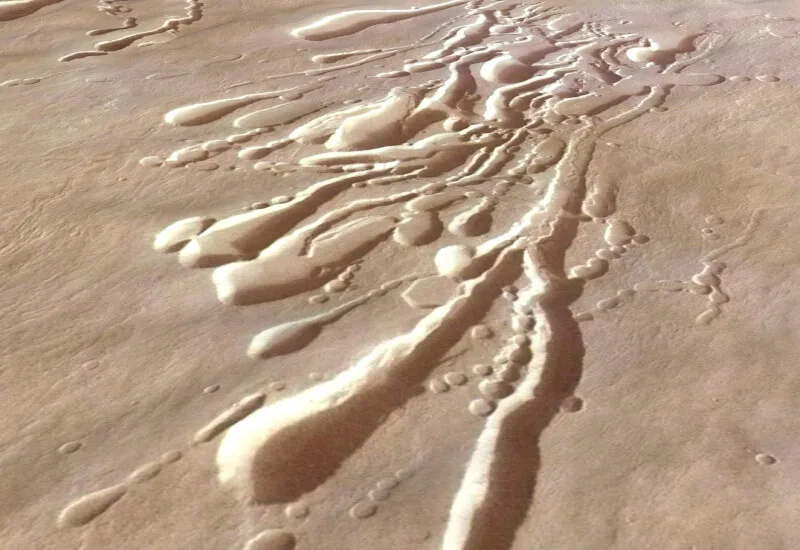
Exploring the underground environment of Mars remains a significant challenge due to the limitations of current rover technology. Large lava tubes beneath the Red Planet’s surface could offer valuable insights into Mars’ geology and potential habitability, but their narrow and irregular passageways are inaccessible to rovers such as Curiosity and Perseverance. A novel concept introduced by scientists aims to overcome this obstacle by deploying a swarm of tiny flying probes delivered by a spherical robotic vehicle.
The proposed system involves a ball-shaped robotic carrier designed to reach Martian lava tubes through cave openings or skylights. Once inside these subterranean networks, the robot would release thousands of miniature flying drones modeled after the aerodynamic properties of dandelion seeds. These bioinspired drones would disperse throughout the tunnels, navigating tight spaces and gathering critical data.
Drawing inspiration from the natural seed dispersal mechanism of dandelions, the drones are designed to remain airborne for extended periods with minimal energy consumption. Their lightweight and compact structure would allow them to maneuver through the complex configurations of lava tubes where larger autonomous vehicles cannot traverse.
Mapping underground lava tubes is of high scientific interest because these formations are thought to provide shelter from harsh surface conditions, including radiation and extreme temperatures. A detailed understanding of their topology could help identify potential sites for future human exploration or even possible microbial life refuges.
Currently, the Curiosity and Perseverance rovers have conducted extensive surface exploration but are physically incapable of entering these cavernous environments due to their size and the risk of becoming trapped. The swarm drone concept aims to complement surface missions by providing access to unseen interiors of Martian caves, thereby expanding the scope of planetary exploration.
While details such as the system’s deployment timeline, operational endurance, and communication methods remain under development, the idea marks a significant step toward utilizing biomimicry in space robotic applications. By leveraging natural flight adaptations, this approach could open new frontiers in the exploration of subsurface planetary environments.
Researchers suggest deploying a spherical robot carrying flying drones inspired by dandelion seeds to map Martian lava tubes inaccessible to rovers.