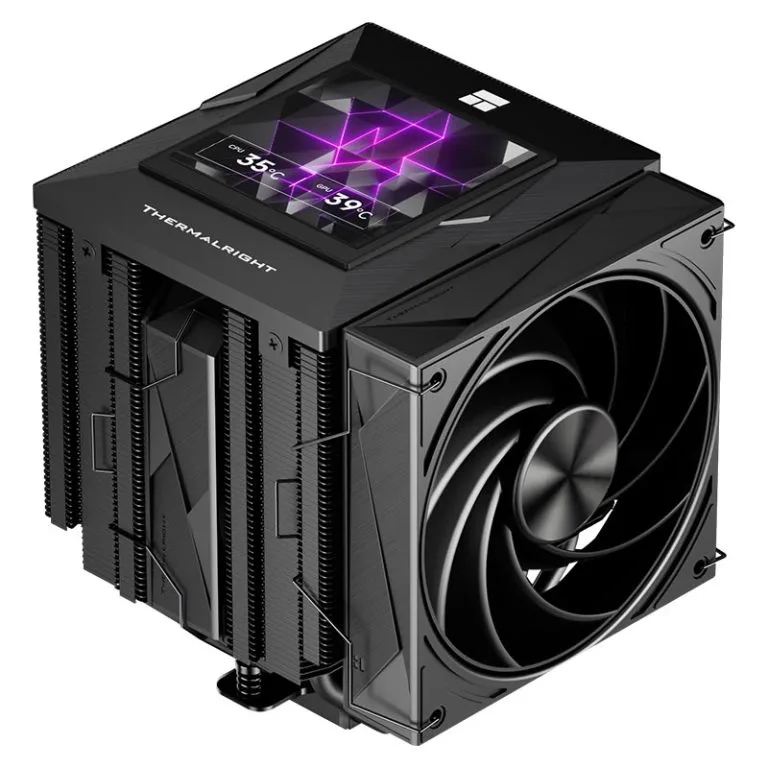
Thermalright Introduces Royal Pretor 130 Vision Cooler with Integrated 3.95-Inch Color Display
July 21, 2026

Huawei Technologies has recently unveiled a novel strategy in chip design and manufacturing that could allow for producing semiconductor components matching the performance of leading foreign solutions, without relying heavily on advancements in lithography.
The announcement caught the attention of Nvidia’s founder and CEO, who acknowledged the significant progress Huawei has made in this area. He recognized the innovation as a breakthrough in chip-making technologies, underscoring the company’s capability to narrow the performance gap with international competitors despite current lithography constraints.
Despite the praise, the Nvidia CEO maintained that the dominant position of Taiwan Semiconductor Manufacturing Company (TSMC) in the global semiconductor market remains unthreatened by Huawei’s developments. He emphasized that while Huawei’s progress is notable, TSMC’s leadership is secure due to its extensive manufacturing scale, advanced processes, and strong industry partnerships.
Huawei’s approach appears to focus on optimizing chip architectures and production methodologies to sidestep the traditional limitations imposed by lithographic technology. This method could provide a strategic advantage, allowing the company to compete effectively without the immediate need for next-generation lithography nodes.
This breakthrough is particularly significant amid an ongoing global semiconductor race where supply chain issues and technology access continue to shape competitive dynamics. Huawei’s innovation could potentially ease some production challenges and enhance its position in the semiconductor sector.
Industry observers are keenly watching the implications of Huawei’s manufacturing techniques as they could signal a shift in how chipmakers approach performance improvements in the absence of lithography advances. Nonetheless, the scale and resources of established industry leaders like TSMC still present considerable barriers to challengers.
Further details about this new chip design and production technology were not extensively disclosed, leaving room for speculation about its technical specifics, potential applications, and impact on market competition.
Nvidia’s CEO praised Huawei for advancing chip production methods that rival foreign competitors without major lithography improvements.