
Anthropic Faces Lawsuit Over Disputed Usage Limits on Premium Claude AI Plans
June 16, 2026
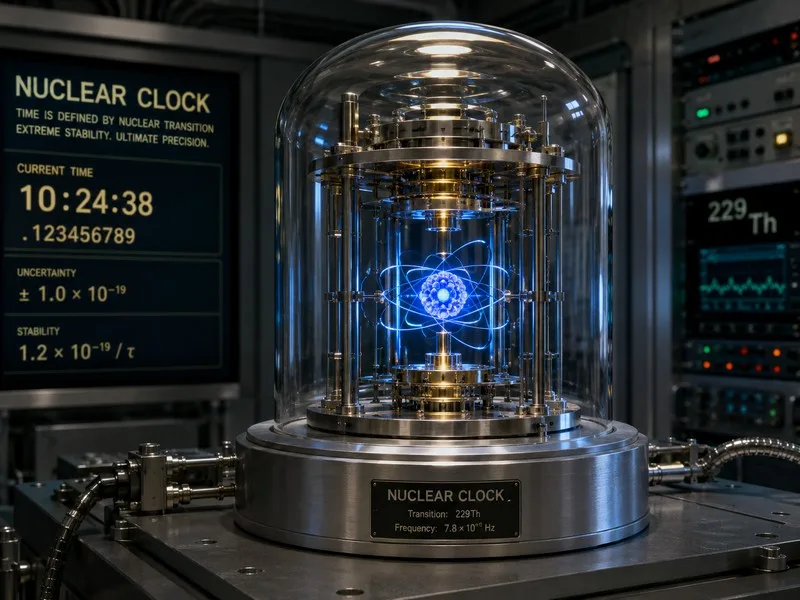
In a pioneering achievement, physicists have developed and operated the first functional nuclear clock, a device that promises to surpass the precision of current atomic clocks. Unlike atomic clocks that rely on electron transitions between energy levels, nuclear clocks measure time based on transitions within the atomic nucleus itself.
The concept of nuclear clocks has been contemplated for several decades, but only recently has it been possible to realize this vision experimentally. Conventional atomic clocks determine time by monitoring the frequency of electrons jumping between energy states around the nucleus. However, nuclear clocks utilize the transitions inside the nucleus, which are inherently less susceptible to external disturbances, potentially leading to unprecedented accuracy in time measurement.
This breakthrough could significantly enhance the precision of various technologies dependent on exact timing, including global positioning systems, telecommunications, and scientific experimentation. By harnessing the unique properties of nuclear transitions, these clocks might achieve stabilities and accuracies beyond what currently available atomic clocks offer.
Moreover, the sensitivity of nuclear clocks to fundamental physical constants makes them valuable tools in probing new physics. Notably, their precision could aid in the search for dark matter, an elusive form of matter that interacts very weakly with conventional matter and forces. Any subtle changes in the nuclear transition frequencies might reveal interactions with dark matter particles, offering new insights into its nature and distribution.
The successful demonstration marks a critical step towards deploying nuclear clocks in practical applications and fundamental research. As developments continue, they may revolutionize precision timekeeping and deepen understanding of the universe’s fundamental components.
A team of physicists has demonstrated the first working nuclear clock, promising greater accuracy than atomic clocks and new avenues for dark matter research.